Story
Richard Kalina: When
Everything Felt Possible
The following is based on an interview with the artist, Richard Kalina, conducted by Jared Quinton on August 11, 2025. Jared is an independent curator and writer based in Connecticut. He was previously the Emily Hall Tremaine Associate Curator of Contemporary Art at the Wadsworth Atheneum Museum of Art Hartford, CT.
Jared Quinton: Hello Richard. I don’t know if you remember, but we met in early 2022.
Richard Kalina: Oh, yes, I do.
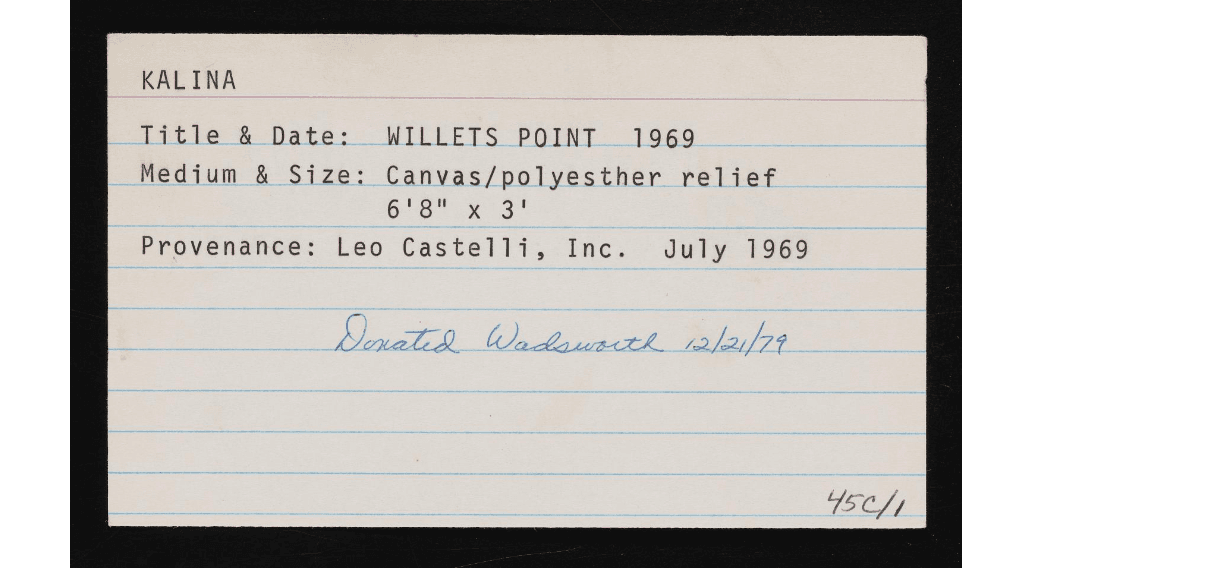
Jared Quinton: You came down to the Wadsworth Atheneum to see your work [Willetts Point, 1969, Gift of Mr. and Mrs. Burton Tremaine to the museum in 1979] with your wife, Valerie [Jaudon], right?
Richard Kalina: That’s right.
Jared Quinton: And Patty Hickson was the curator at the time. I had just accepted the position as her fellow, but then she left pretty soon after I started, so now I have the position.
Richard Kalina: Great. So, what is your actual job title?
Jared Quinton: I’m the Emily Hall Tremaine Associate Curator of Contemporary Art. And in a way, that title explains why I’ve asked you to speak today. The Tremaine Foundation has created the Tremaine Collection digital archive that brings the collection back together online, where people can learn about the works that were collected by Emily and Burton, as well as hear some of the stories behind the collection and behind Emily as a person. They’ve asked me and a few other curators with connections to the foundation to speak with some of the dealers that they worked with, like Larry Gagosian and Arne Glimcher. And they’ve also been publishing interviews with some of the artists that were part of the collection as well.
Richard Kalina: Particularly the living ones.
Jared Quinton: Particularly the living ones, which I’ll be honest, there’s not so many of them.
Richard Kalina: Tell me about it, I know.
Jared Quinton: But I’m thrilled to speak with you. I want our interview to touch on the Tremaine connection in any way that you’re able to speak about it, as well as the work of yours [Willets Point] that was in the Tremaine Collection, that’s now in our collection. But other than that, I’m just really interested to hear from you more generally about the early few decades of your career, and then maybe any reflections that you have looking back at it now. To start, can I ask you about your decision to study at the University of Pennsylvania and what it was like there as a student in the early ’60s?
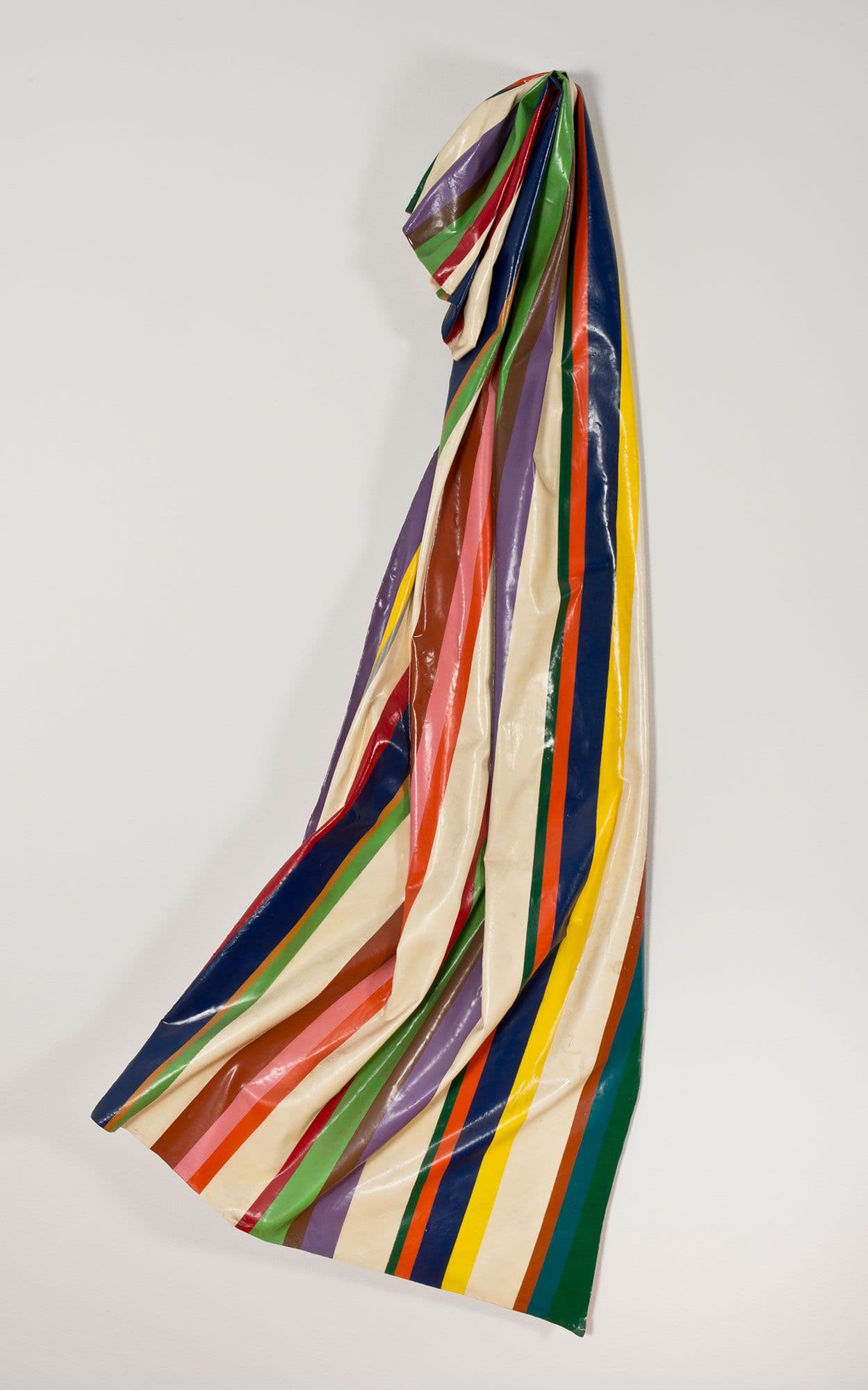
Richard Kalina, Willets Point, 1969, Wadsworth Atheneum Museum of Art, Hartford, CT, Gift of Mr. and Mrs. Burton Tremaine.
Richard Kalina: Just as a prelude, I do like to talk. I talk, I write, I teach. I like to talk, but I’m not particularly happy talking about myself. I mean, I’ll do it, but there are a lot of people who like to talk about themselves. It’s an interesting thing for them. For me, less so. On the other hand, I’m very pleased to do this.
Penn was great. I liked it. It was fun. You know, I was very young. I was a, shall we say, beneficiary/victim of a rather misguided educational experiment, which was if you had kids who looked like they were smart, let’s just challenge them more, not by giving them more interesting courses or anything, but just let’s skip them over. So, there I was, two years younger than everybody else. And of course, with parents who were strict, so well, it led to, shall we say, risky behaviors. Anyway, but I had a good time. And then after that, I went up to Boston for work for a little bit, and then in the fall of ’67, I came to New York. And I had studied art at college and I decided, well, I’ll do this. I’ll try this. And, you know, everything feels possible when you’re, when you’re 20, 21.
It was very interesting. I ended up in this really quite interesting building. Since you’re speaking to Neil [Jenney], you might wish to go and look up an issue that came out last year of Ursula Magazine, which is, you know, a Hauser and Wirth magazine. It’s written by Erik La Prade and Erik worked on this a long time. And it’s about this building, which was a very, very interesting building. I got my loft from Brice Marden. And so it was, they had a history of interesting artists being in there. It was pretty primitive. And I lived right above Neil on the fifth floor. It was one of these things where you could actually look through the walls because the mortar was missing in a lot of it. And I moved there in September of ’67. And then Brice moves up in the world and moves out. And it was a rental from this very strange fellow named Jack Klein, who owned this building. And, you know, it was there. And as I was looking around, I had to pay $300 in key money. And Neil was already there. They had a bunch of other people that had come about a year before I did. And I said, where’s the controls for the heater? And Brice said, oh, no, there’s no heater. I said, really? And there was this little teeny stove. I mean, a little teeny two-burner gas stove that looked like it came from like 1910. And he said, well, you can use the stove. I said, oh, really? He said, yeah, yeah, it works. In any case, the loft was big, 800, 900 square feet, something like that. It was the biggest place I’d ever been.
“It was very interesting. I ended up in this really quite interesting building. Since you're speaking to Neil [Jenney], you might wish to go and look up an issue that came out last year of Ursula Magazine, which is, you know, a Hauser and Wirth magazine. It's written by Erik La Prade and Erik worked on this a long time. And it's about this building, which was a very, very interesting building. I got my loft from Brice Marden. And so it was, they had a history of interesting artists being in there. It was pretty primitive. And I lived right above Neil on the fifth floor.“
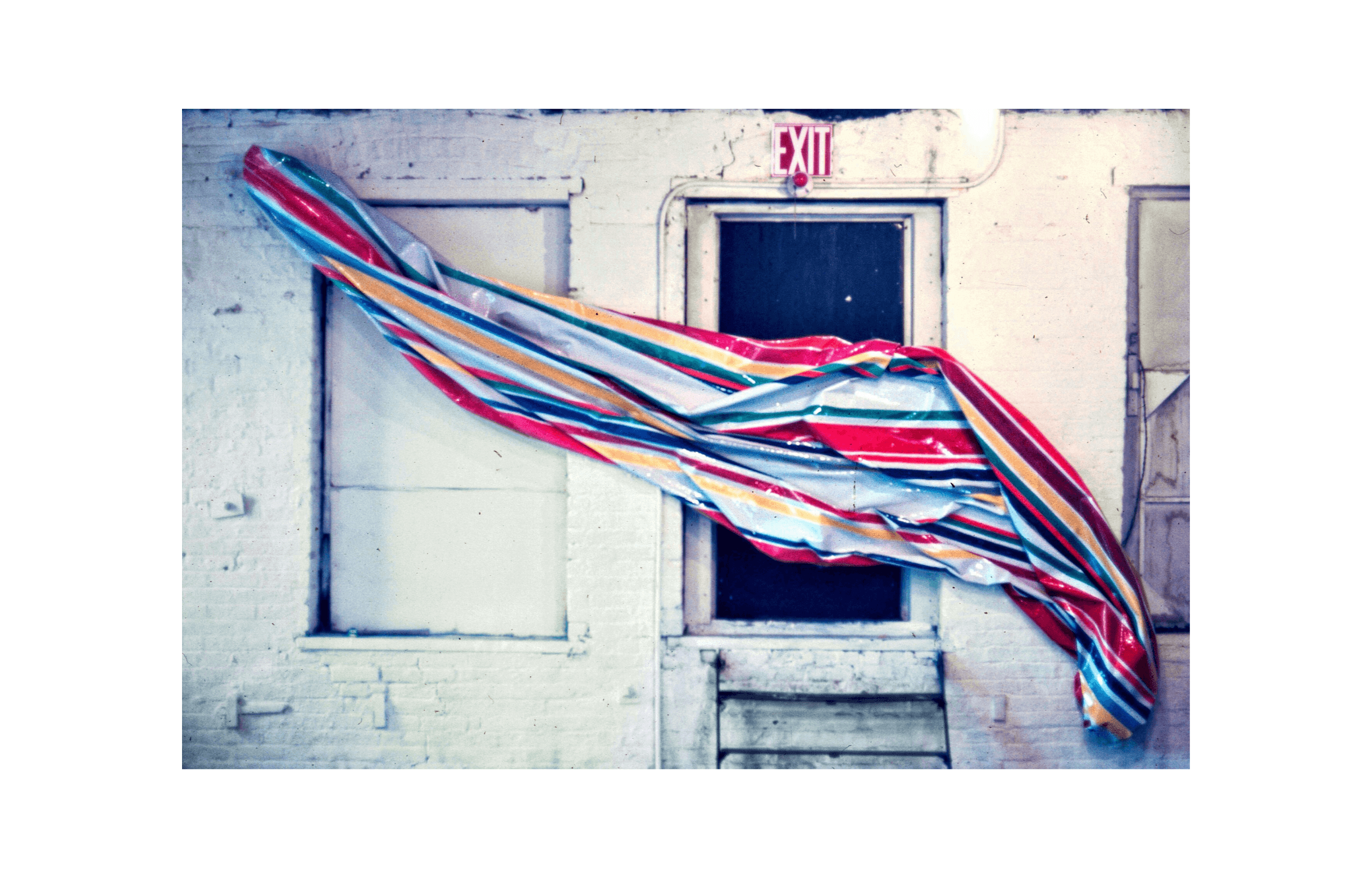
76 Jefferson Street, 1968
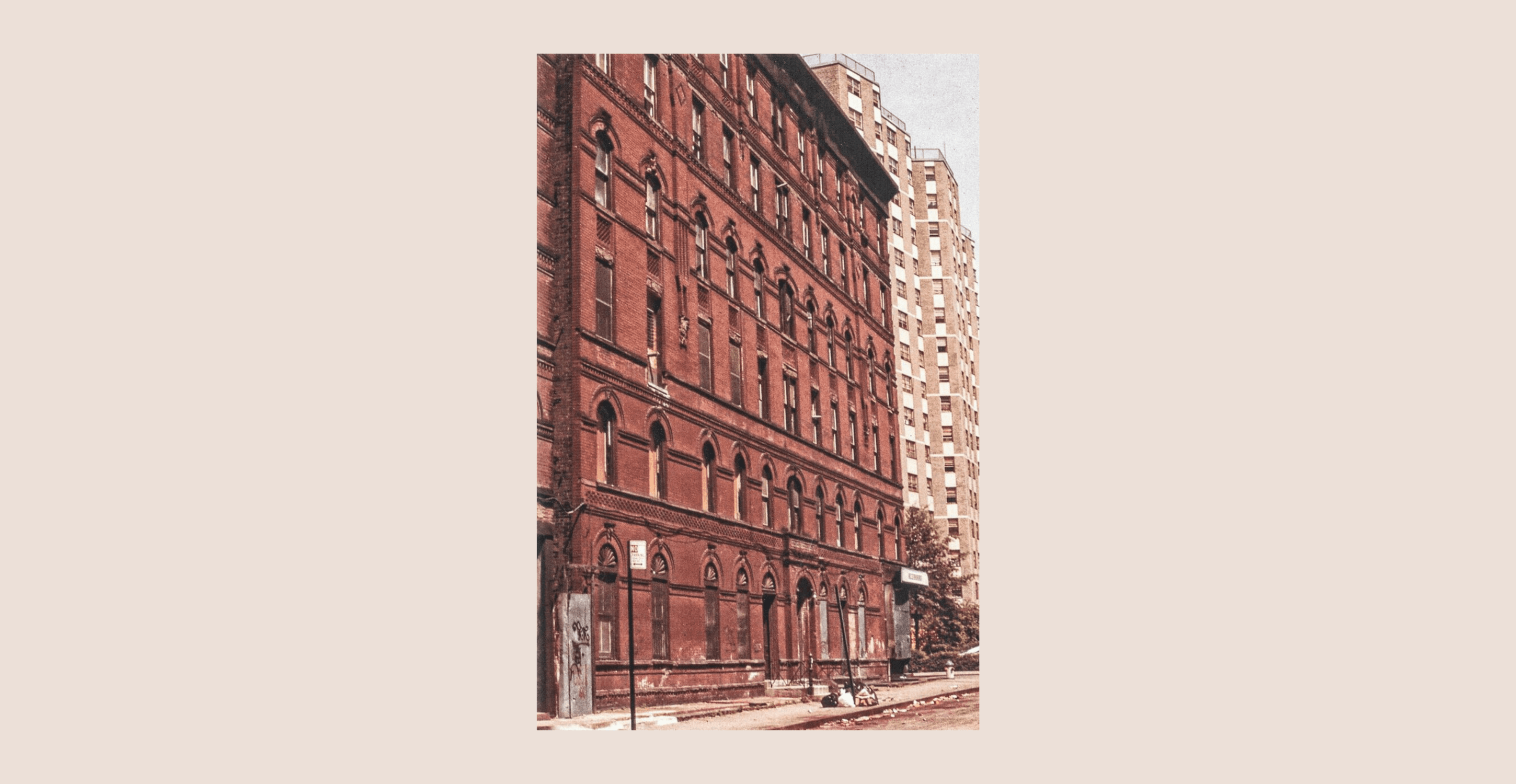
Background image: Richard Kalina, Untitled, 1968. Installed on the interior of 76 Jefferson Street. Courtesy the artist. Foreground image: Exterior view of Jefferson Street, 1968. Courtesy Richard Kalina.
Jared Quinton: And tell me how your career got started, both as an artist and as an arts worker.
Richard Kalina: I started doing this work with these [industrial, experimental] materials. And because, you know, it was in the air, right? There was a lot of things that were happening kind of around the same time, as you might know. There was color field painting, people like Kenneth Noland. There was Frank Stella’s work. And everybody was looking at this stuff. But there was John Chamberlainand Claes Oldenburg.And so I thought, you know, kind of make a synthesis of them, which I did. And I took my slides... I said, I’ll just try the Castelli Gallery, because it’s the best gallery. I’ll just go and see what happens. And Ivan Karp was the director of the Castelli Gallery at the time. And he looked at it and said, can I come down today? And I said, no, I was busy. How stupid was I? In any case, from there, things went very well. I started selling, showing work in 1968 and had a couple of shows then. In ’69, I had five group shows. In ’70, I had 10. And so I was, at the beginning, when I came to New York in ’67, I got a job. Well, first, I got a really great job at Curtiss-Wright Aviation. It was a very big place, you know, people that made airplanes, particularly during World War II. And they had this gigantic factory in northern New Jersey. My job, along with a bunch of other people, was to go and ask people what they did—it was sort of the early version of management consulting stuff, I guess. And they all talked to us because I think they thought their jobs were on the line because Curtiss-Wright had made a poor business decision, which was to think that jet engines were just a passing fad. So, they ended up basically making parts for their old planes.
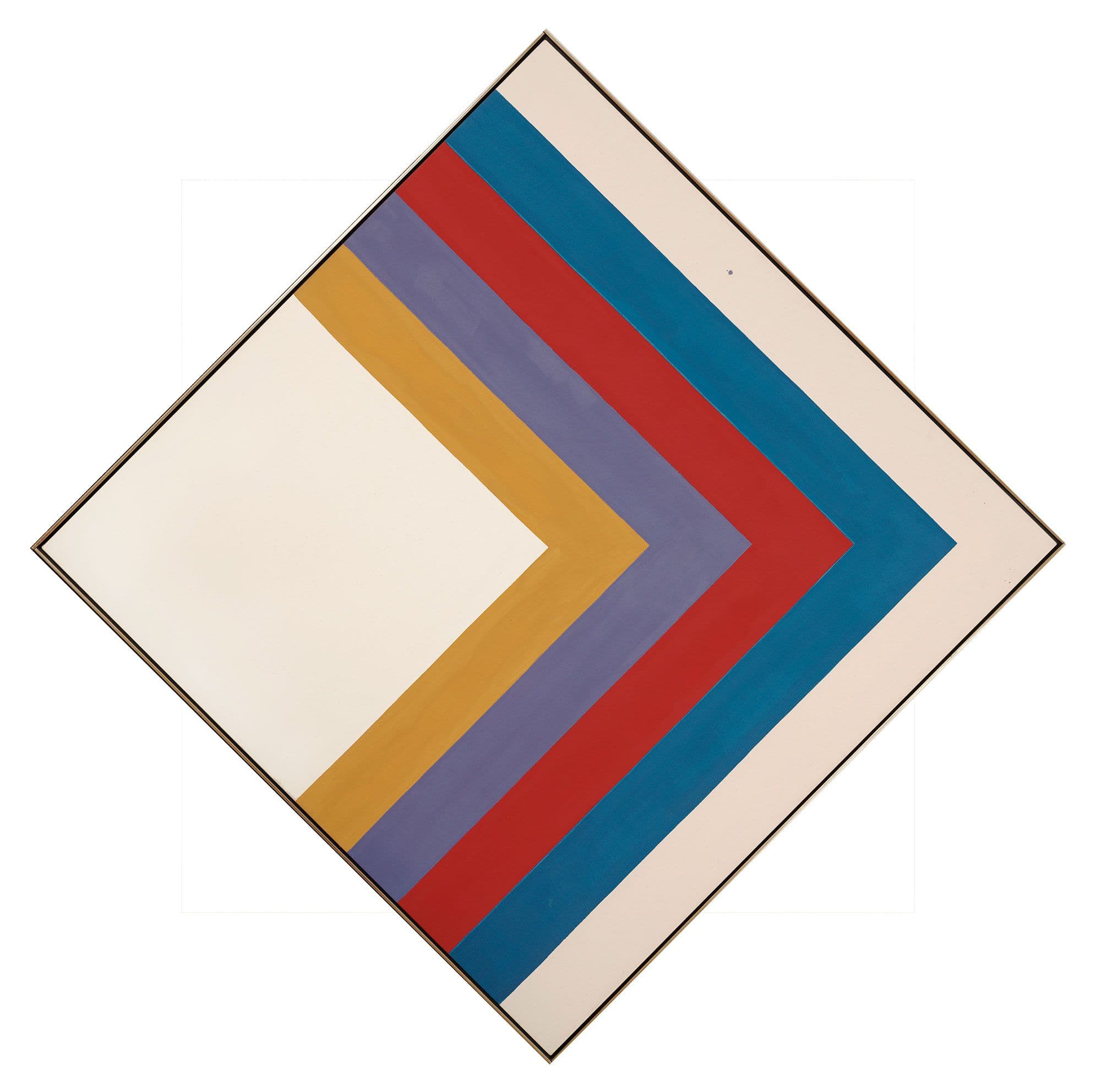
Stack, 1965 by Kenneth Noland, Wadsworth Atheneum Museum of Art, Hartford, CT, Gift of Mr. and Mrs. Burton Tremaine, 1979.220. © Artists Rights Society (ARS), New York.
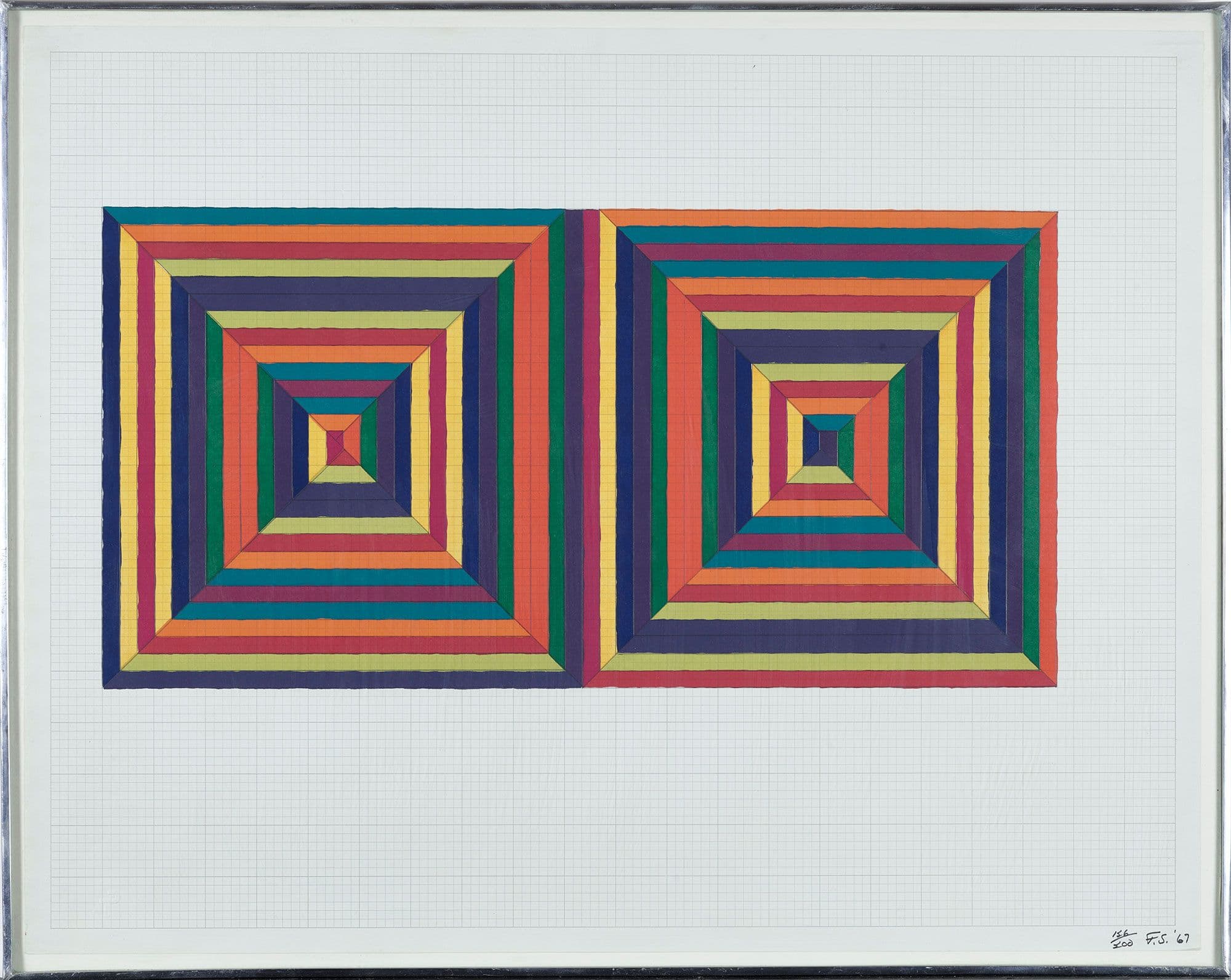
Untitled by Frank Stella, Wadsworth Atheneum Museum of Art, Hartford, CT, Gift of Mr. and Mrs. Burton Tremaine, 1975.160. © Frank Stella / Artists Rights Society (ARS), New York.
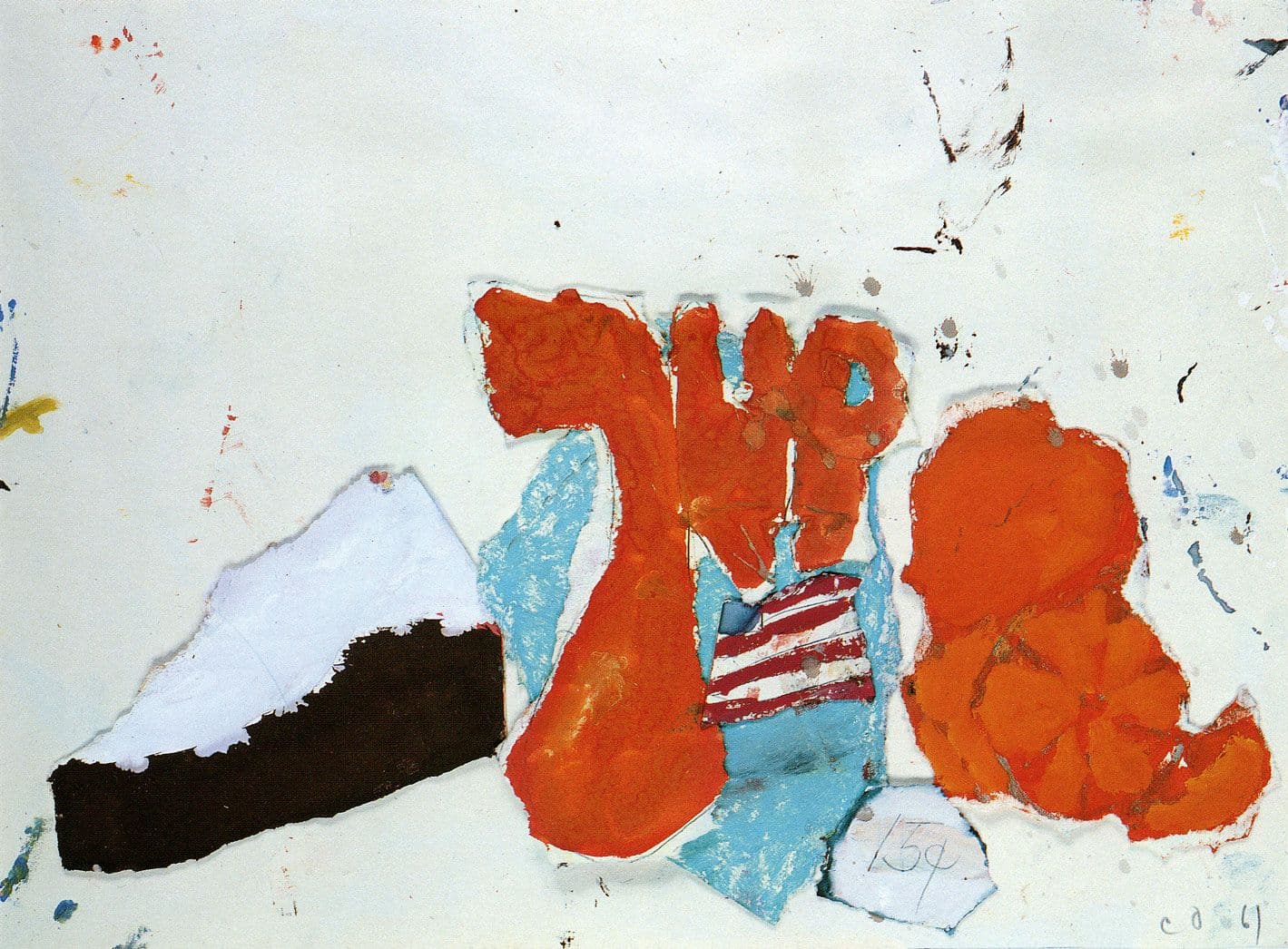
Claes Oldenburg, Studies for Store Objects – Pie, 7-Up, Flag, Oranges, Fifteen Cents, Year of Christie’s sale: 1988, © 1988 Christie’s Images Limited.
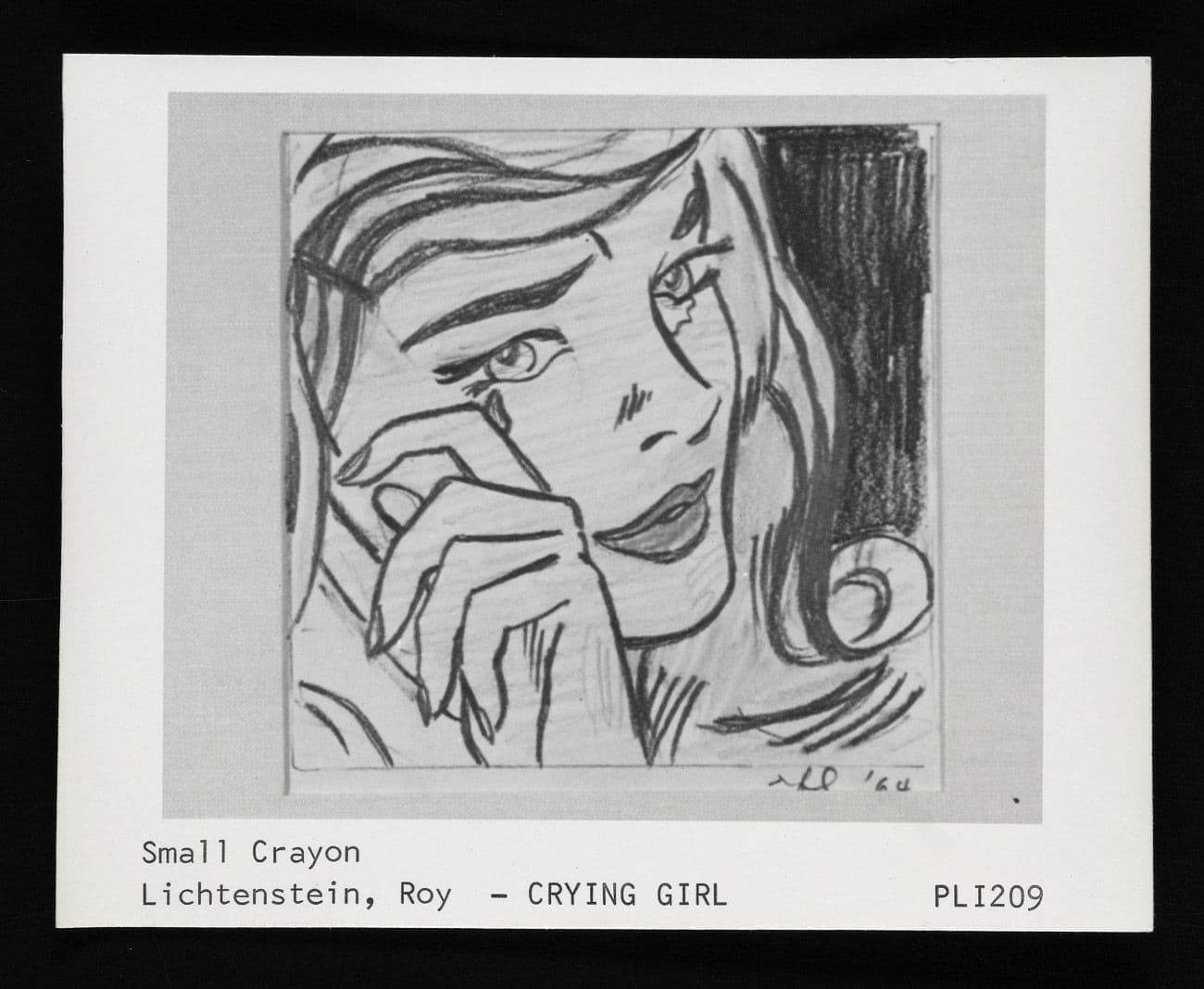
Richard Kalina: In any case, after that, I worked very, very briefly for the welfare department, which was not much fun. Going out and visiting people in Brooklyn and seeing what they needed. And then I went in and took my, as I said, I took my slides up to Castelli and they started working with me, which is very nice. And I said, well, I hate this job. Can I get another job? So, at that point I started working for Roy Lichtenstein, as his assistant, which was really nice. Roy was a very, very interesting and funny and very hardworking man. He had a studio on the Bowery and it was great working for him. And then after that, I worked at the Castelli Warehouse, which was, if you look, it was a very interesting place. Do you know about it?
Jared Quinton: I don’t really, no. Tell me.
"So, at that point I started working for Roy Lichtenstein, as his assistant, which was really nice. Roy was a very, very interesting and funny and very hardworking man. He had a studio on the Bowery and it was great working for him."
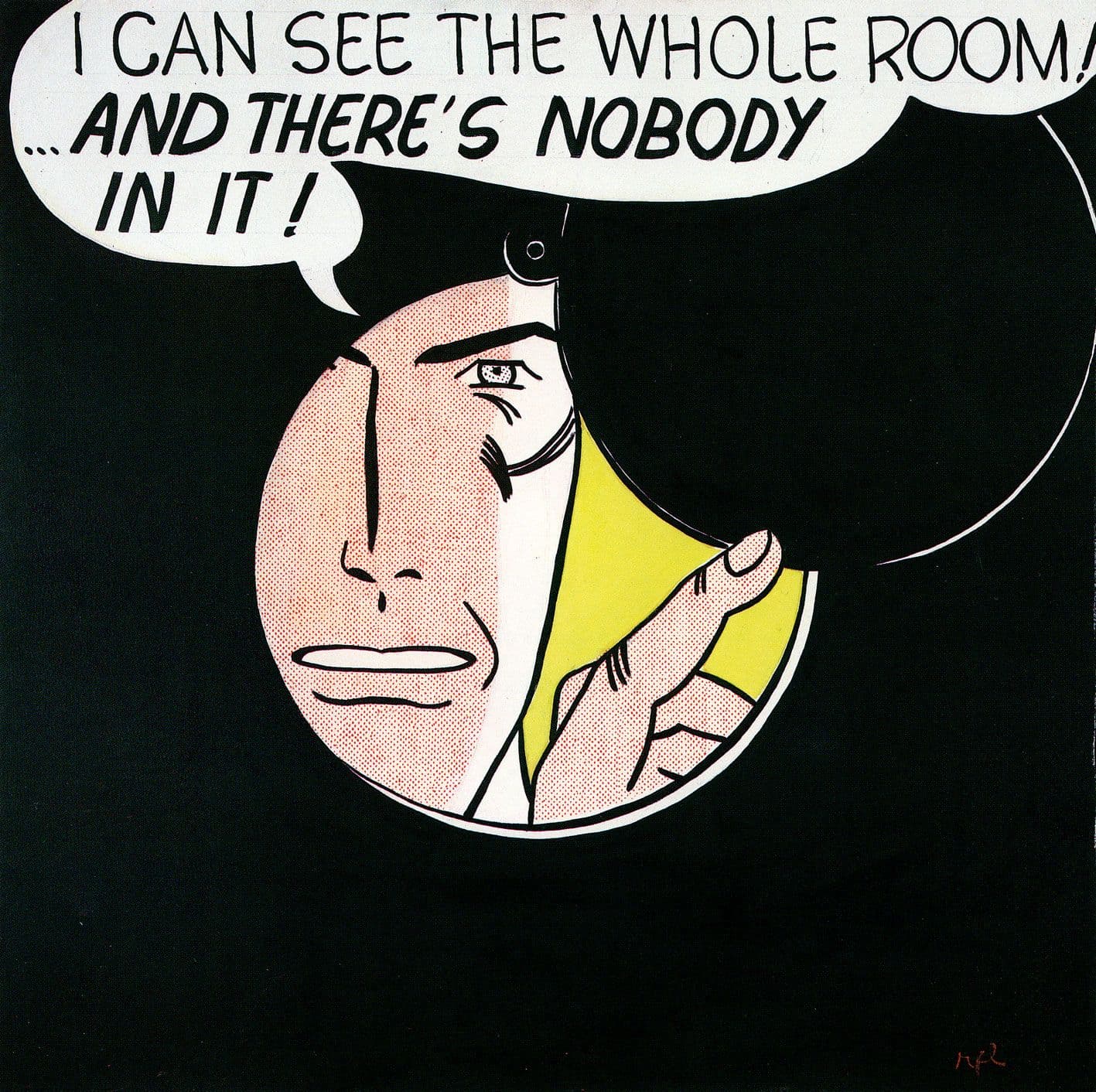
Roy Lichtenstein, I Can See the Whole Room...and There’s Nobody in It! Year of Christie’s sale: 1988 © 1988 Christie’s Images Limited.
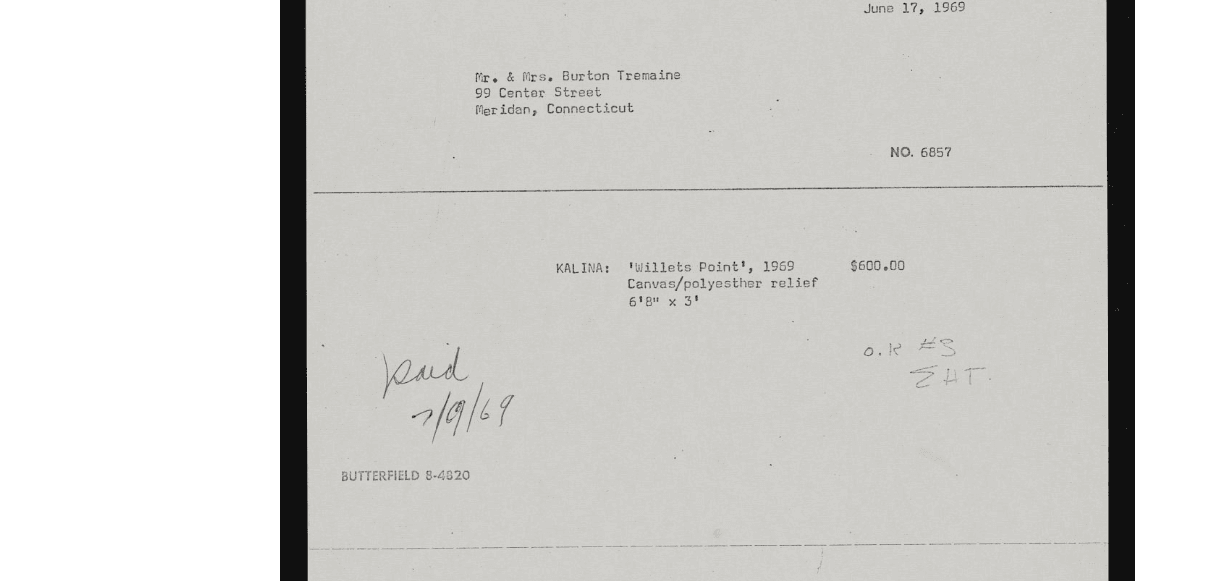
Richard Kalina: One of the exhibition venues they had was the warehouse. It was on 108th Street and it was owned by an art moving company named Hague Art Deliveries. And they had a group of galleries in there. They had Sonnabend in it and then Castelli. And so it was my job—this was a dream job—all I had to do was sit at a card table and make sure that nobody stole anything. And if you look at the exhibitions they had, they were fantastically interesting exhibitions. And they also said, oh, Kalina, just go put your work up on the wall. And I said, Okay. And so I did. And I don’t know, they would come by. And I met Gianni Agnelli because he came by and he said, oh, I like that. I’ll get that. And so it was very nice. And then there was a show there at the Castelli Gallery. And that is where the Tremaines bought Willets Point. I met them briefly. They seemed absolutely lovely people. And for years, I’ve had that book about painting and architecture [Painting Toward Architecture].
“And they also said, oh, Kalina, just go put your work up on the wall. And I said, Okay. And so I did. And I don’t know, they would come by. And I met Gianni Agnelli because he came by and he said, oh, I like that. I'll get that. And so it was very nice. And then there was a show there at the Castelli Gallery. And that is where the Tremaines bought Willets Point. And there's actually a picture of it there on the site, if you look at it. And so I met them briefly. They seemed absolutely lovely people."
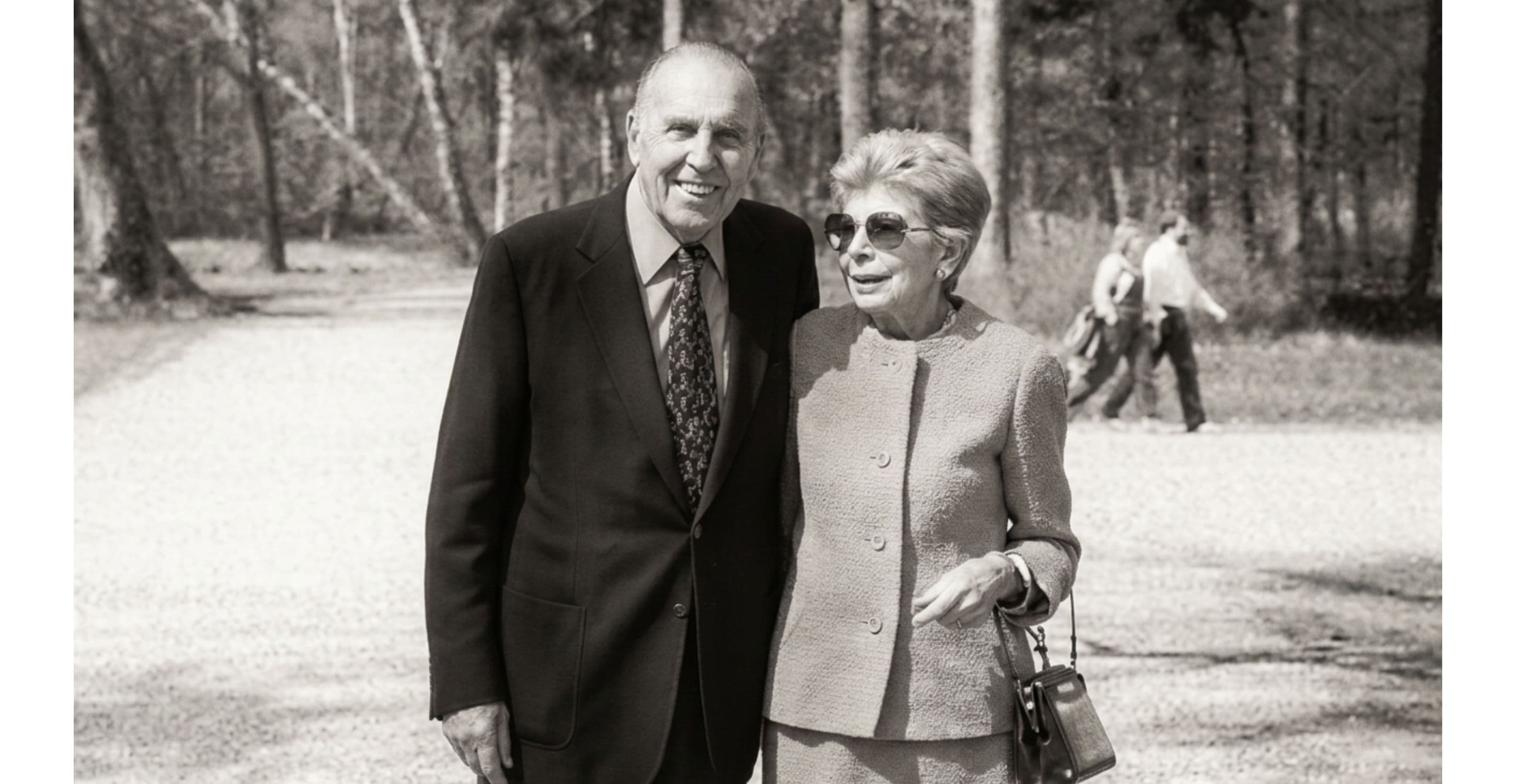
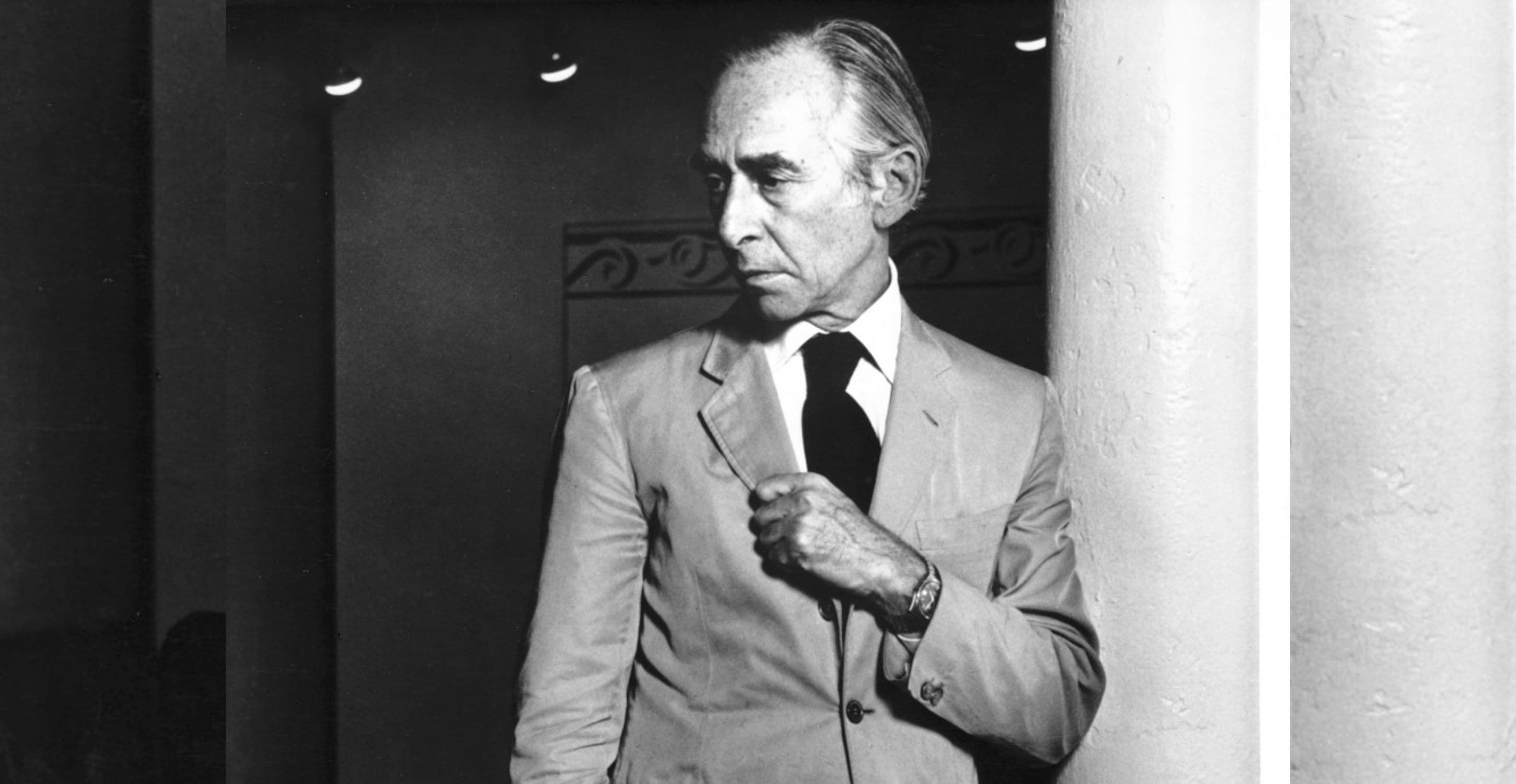
Burton and Emily Hall Tremaine, circa 1950's.
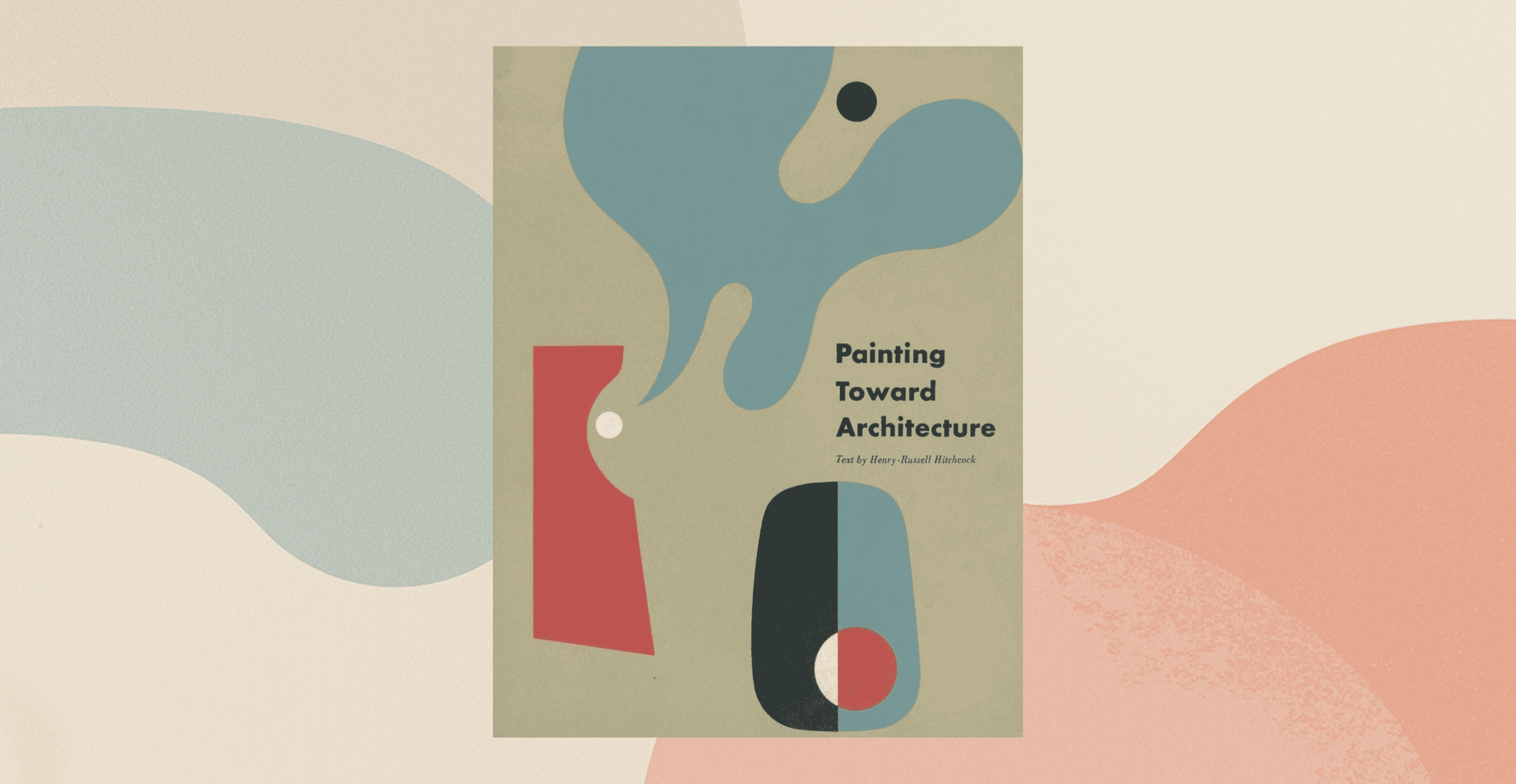
Background image: Burton and Emily Hall Tremaine. Photo courtesy of the Tremaine family. Foreground image: Painting Toward Architecture, text by Henry-Russell Hitchcock, 1948. Image courtesy of the Tremaine Foundation.
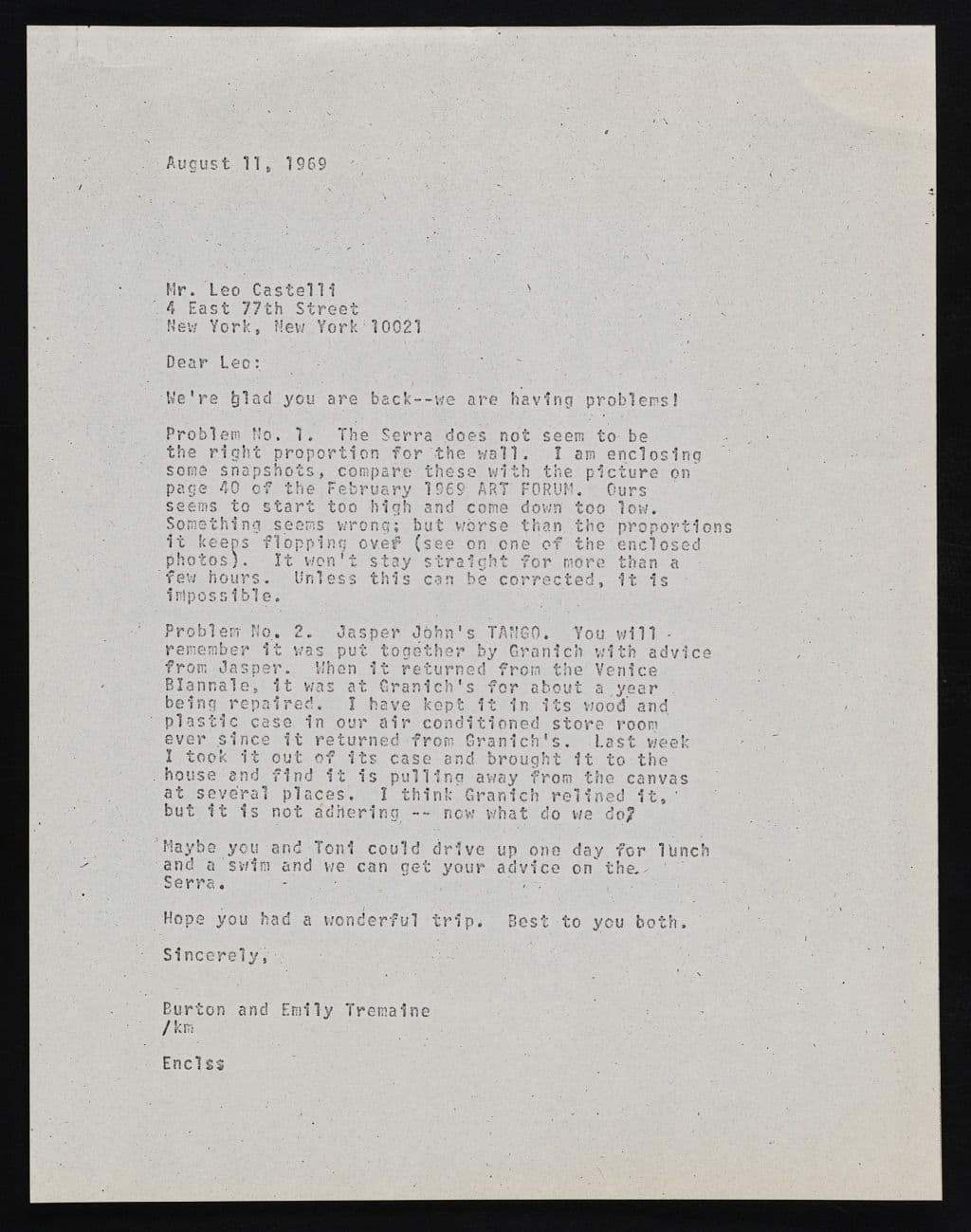
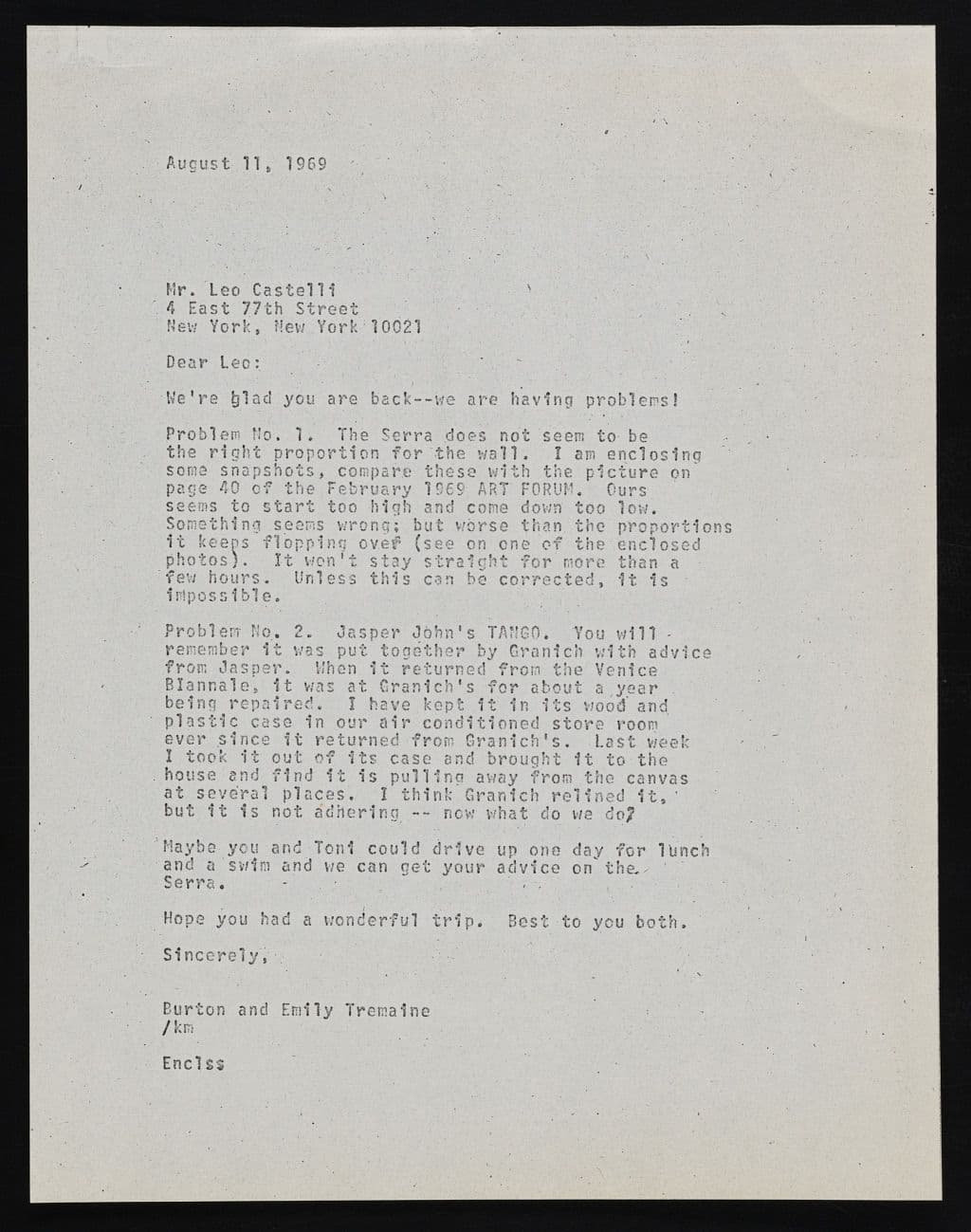
Richard Kalina: It was a very, very interesting time, a transitional time. That is, in the late ’60s, with few exceptions, the first-generation Abstract Expressionists were still around, and you could meet them. They weren’t all that distant. And then you had the sort of early Minimalists coming up around the early to mid-’60s. And then, as I’m sure you know, post-Minimalism happened around the same time as Minimalism. And of course, as I’m sure you know, Richard Serra starts off as a post-Minimalist and then becomes a Minimalist. But at the Castelli Gallery, they had absolutely wonderful shows there at the warehouse. And that was the real center of art then. So, I got to meet a lot of interesting people. I met Jim Rosenquist, who bought work. I met George Segal, who we got to know very well. And I met Robert Rauschenberg and Andy Warhol. And then later on, I got to know Keith Sonnier very well. And I met Richard Serra. Would you like to hear a story about Richard Serra?
Jared Quinton: Why not? Of course.
Richard Kalina: Why not? You know the kind of fellow he was, right? Mr. Subtle. I think he was like the greatest of those sculptors. But I was sitting there when I was working at the warehouse. And there was a really interesting kind of retrospective of Robert Morris, and there was this piece there called Continuous Project Altered Daily. It was a significant piece of his work. In fact, it was the title of a study of his life. And so it was this room that he just, it was in his “scatter” period, where he would take a lot of different things and move them around and he would come in. And there was this room that was closed off by a velvet rope. And he would come in every day and mess things around with it. You know, he would add, it was all kinds of detritus that one would find in Soho and stuff, oil cans, sand, construction materials, just, you know, post-industrial crap, essentially. And so he would come in and alter it every day.
And anyway, I’m sitting there, minding the store, so to speak. They had by the way, incredible art that was stored there. So they had an exhibition area, but also that’s where all their storage was, you know, incredible, incredible Rauschenbergs and [Jasper] Johns and Oldenburgs and wonderful Jim Rosenquist sculpture called Tumbleweed, which is one of the great sculptures. It was, it’s a neon, these are neon and barbed wire and kind of crossed four by fours. You should look it up.
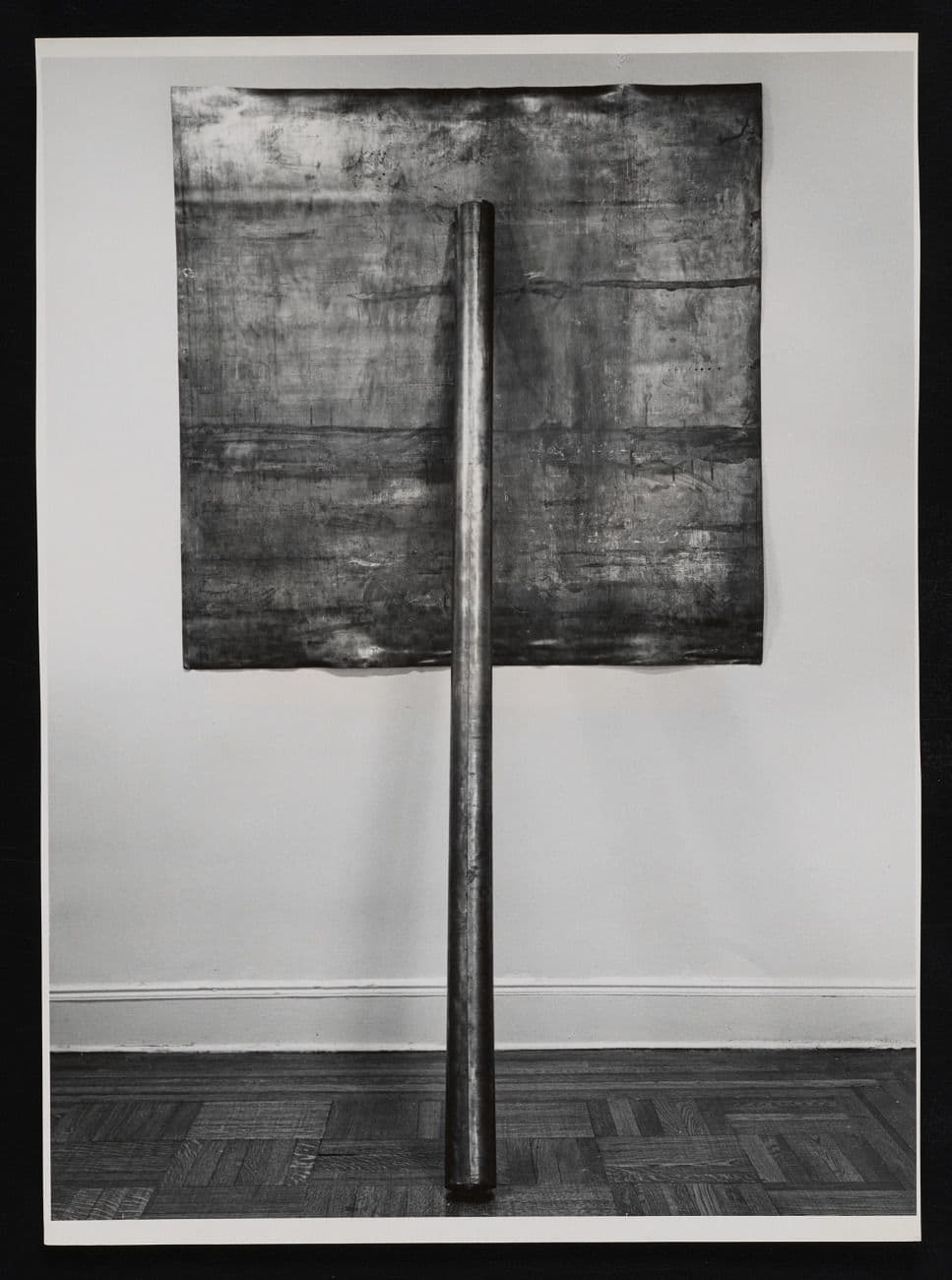
Prop by Richard Serra, Emily Hall Tremaine papers, circa 1890-2004,
Archives of American Art, Smithsonian Institution.
© Artists Rights Society (ARS), New York.
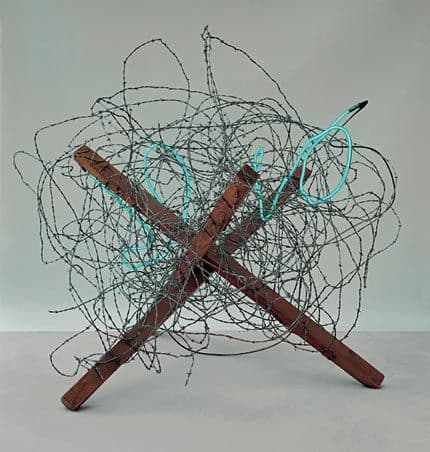
Tumbleweed by Jim Rosenquist, image in public domain, © James Rosenquist Foundation / Licensed by Artists Rights Society (ARS), NY. Used by permission. All rights reserved.
Jared Quinton: I will, I’m writing it down.
Richard Kalina: In any case, so I’m in there and in walks, this is, by the way, a garage. This was a garage. And so it’s a big empty space. So in walks this guy and I recognized him as Richard Serra. And I’m sitting there and he walks over to, he kind of scowls, you know, he kind of walks around and stomps around and scowls at things. And he walks up to the velvet rope across the room and he lifts it up. And suddenly like, what’s happening here? Walks in and starts kicking things around. And I said, I don’t really think you should be doing that. And he said, enunciating each word, it doesn’t matter. I said, okay. And then he left. And after it was over, Bob Morris never said anything to me. He gave me the sign from the exhibition, which I have actually framed. And so that was that.
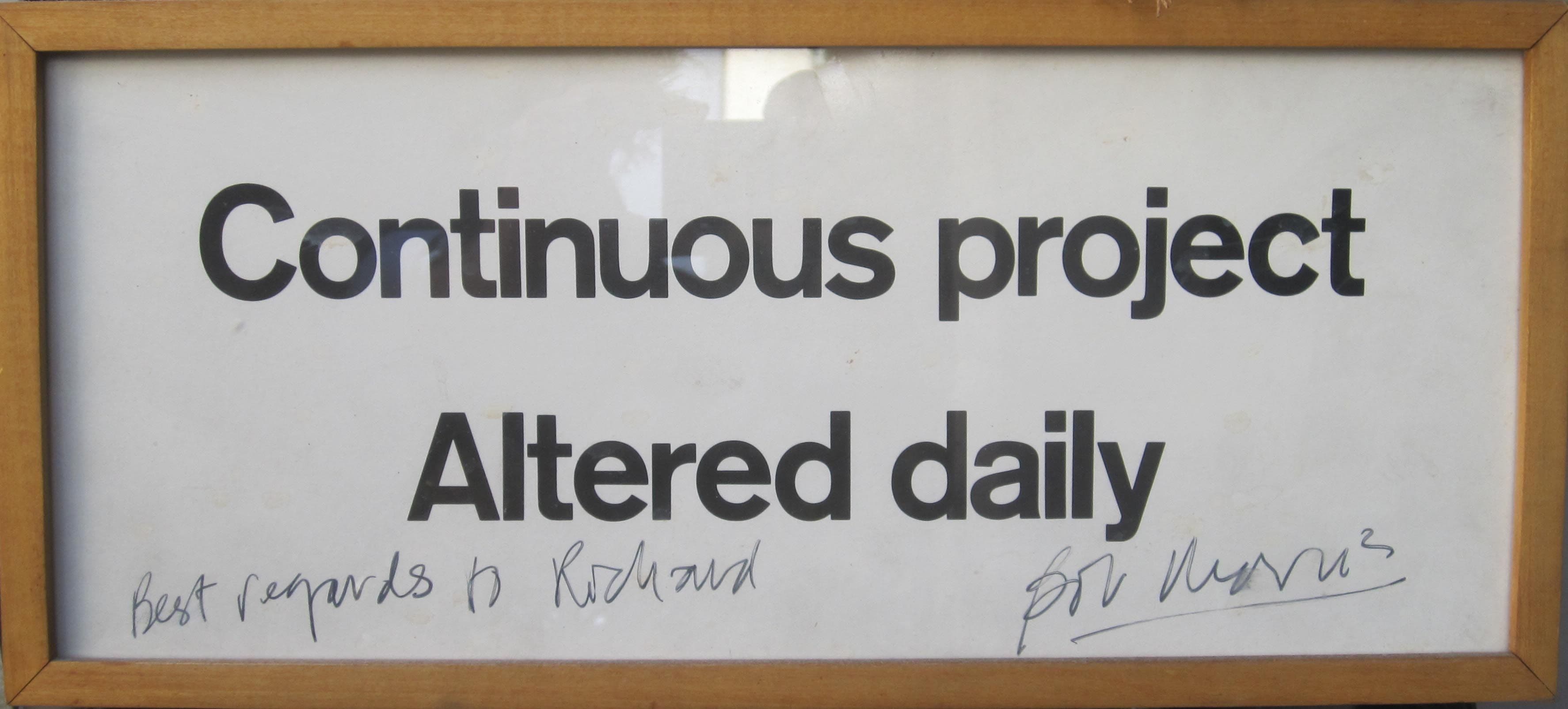
Sign from the Continuous project Altered daily exhibit given to Richard Kalina by Bob Morris. Photo courtesy of Richard Kalina.
Jared Quinton: So you had a lot of success and met a lot of people right away.
Richard Kalina: I started showing in 1968, and my first one-person show was in 1970 when Ivan Karp left Castelli and said, why don’t you come with me? And I said, Oh, sure. Okay. It was really exciting. So things went on from there.
Jared Quinton: I love hearing about just the way that you were working and making art and the way that all sort of seemed to come together. Before we move on to the ’70s, I would love to hear a little bit more about the polyester stripes body of work. Say we have the image of Willets Point in front of us. Can you just tell me a bit about like how you came to what feels like a very signature practice—not necessarily overly technical, but yeah, a bit about how you actually made those works.
Richard Kalina: I can be as technical as you would like.
Jared Quinton: Okay. Great.
Richard Kalina: What I did with these pieces is I had a big roll of canvas, I laid it out on a table and I painted these striped paintings, which were actually, you know, nice acrylic striped paintings. And then I took it—well, it depends on where I did it. At the beginning when I was on Jefferson Street, I did it there. But then when I got another studio on 7th Avenue and 27th Street, I needed more room and I also needed to escape it. And you know, resin is not the most lovely of materials. Remember, at this time, there was a great deal of interest in materials like fiberglass, polyester resin, and stuff like that. And so, on one hand, you had people who were doing it in a more, in a sort of stricter, more geometric manner, like Ron Davis, you know, the California artist? But there were a lot of people who were also using it in a looser way, which is sort of the post-Minimalist people.
And so, what I did is I would then take this off - unstaple it from the table. I would take it and I would cover the back and the front with liquid polyester resin. And then I didn’t have too much time to do it. I went in and formed it into something that had a dynamic form and that often related to issues of hanging and gravity, even though I could go as anti-grav as possible, because, you know, I was doing it flat. And so sometimes they were really clumped up together and very dense, and then sometimes, as in Willets Point, they were more elongated and more looked as if they were taking a natural form from gravity, which they actually weren’t, because they were stiff. And then once they were done and once they were dry, which didn’t take too long, day or two, and then I would give them an extra coat, and then I would turn them over in many cases, depending on how firm they were, and cover the back with fiberglass cloth to further stiffen it and then find some way of hanging it.
"What I did is I would then take this off - unstaple it from the table. I would take it and I would cover the back and the front with liquid polyester resin. And then I didn’t have too much time to do it. I went in and formed it into something that had a dynamic form and that often related to issues of hanging and gravity, even though I could go as anti-grav as possible, because, you know, I was doing it flat. And so sometimes they were really clumped up together and very dense, and then sometimes, as in Willets Point, they were more elongated and more looked as if they were taking a natural form from gravity, which they actually weren’t, because they were stiff. And then once they were done and once they were dry, which didn’t take too long, day or two, and then I would give them an extra coat, and then I would turn them over in many cases, depending on how firm they were, and cover the back with fiberglass cloth to further stiffen it and then find some way of hanging it."
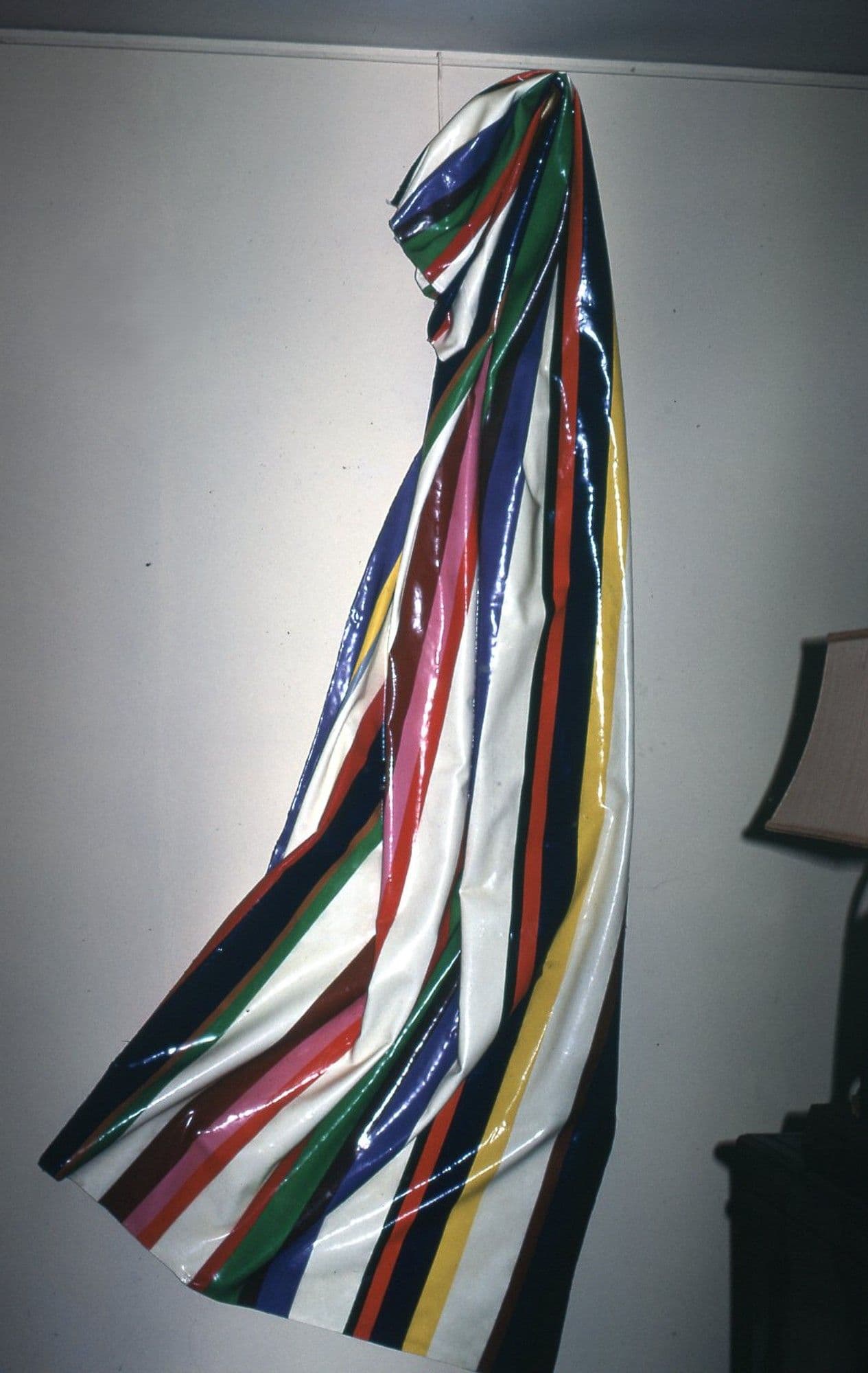
Willets Point displayed in the Tremaine home. Photo courtesy of the Tremaine family.
Richard Kalina: So that’s the way it was done. And when I got the studio on 7th Avenue, it was a penthouse studio, so I took that. It was a compressor. I had this mask. It was a compressor that had a long hose, and it led into a mask. So I put the hose out on the roof, and I worked around it. So that’s the way it worked. I did a lot of these things. I had a lot of energy, and they were doing very well. I mean, I sold a very large number of them. But it wasn’t the world’s healthiest material. And there was an article that came out at the time by an artist named Robert Mallary, and it was about health hazards for artists, and it affected a lot of people. And people were like, oh, I don’t know about that. And so after a while, I just said, maybe I should think about something else.
So I did. And then I started painting, and things went from there on. But it was a very exciting time, I thought. Things were, of course, I mean, when you’re 21, 22, 23 years old, things are exciting. And so it was lots of fun. And I met Valerie [Jaudon] on October 23, 1969, and we’ve been together ever since.
Jared Quinton: Aww, that’s amazing.
Richard Kalina: And yeah, so she’s been a fantastic help to me and a great companion. And she’s a very good artist.
Jared Quinton: Very good, yeah.
Richard Kalina: And so it’s been a nice life. One of the people I met when I was working at Castelli Warehouse was an artist who was a sculptor, but he was an art restorer, and he was working on restoring John Chamberlain’s work, named Martin Craig. And Martin had a house out in East Hampton, which was given to him. That’s an interesting story, if you want to hear it. In any case, anyway, so we ended up in 1980... Martin dies and he was considerably older than my father, but we were great friends. And so this house that he got, we ended up buying from his crazy family. And so in any case, we’ve been here ever since, and so we live in New York and we live out here. And we lived downtown New York for a gazillion years. We lived on Jefferson Street, lived on the Bowery, lived on 20th Street, lived on King Street in Hudson Square for 27 years, and then we moved to Jackson Heights, where we live now, which is fantastic. Do you know that neighborhood?
Jared Quinton: I’ve been a few times. Great food.
Richard Kalina: Great food, but all you have to do is walk a couple of blocks north and you run into something that is a great, I sound like a real estate salesman, something of great, actually, historical interest. It’s a historic district that began in the early teens of the 20th century. A guy named McDougal went in and bought 350 acres of pretty much vacant land, deciding to build something based on Ebenezer Howard’s “garden city movement”, which he was a devotee of. And it was to see if he could entice the upper-middle-class types to come out away from Manhattan, to have some kind of both city thing and country thing at the same time. He built these apartments, the core of them still are there, they’re all brick buildings, four, five, and six stories tall, around block-long gardens. And they’re fantastically beautiful places and cheap, relatively so. We’re happily still there.
Jared Quinton: How close is that to Willets Point?
Richard Kalina: Ah, not that far, actually, as it turns out, not that far.
Jared Quinton: How did that title come about or how did titles in general work for you?
Richard Kalina: Why did that title come about? I just... I don’t know, I would kind of think of titles that seemed sort of place-located or action-located, but a lot... I wanted them kind of evocative. Well, it’s a problem, of course, with abstract art and titles. You don’t want to just have “untitled”. It would be like, if you had a kid, calling a kid Sonny or Junior or something like that, or hey, you. I wanted to have names, but I wasn’t doing series, so I couldn’t be like Frank Stella, who was a great inspiration for title-making. So I just kind of... It was places and things, and there was a place in Queens called Willets Point, and I liked it. Also, since it had a point at the top, it seemed reasonable. I had another thing called Palma Point. Point seemed good. It seemed like a kind of place name and a description. So that’s why.
Jared Quinton: That makes sense..
Richard Kalina: It was sort of a fun name. I think one of the things that has been a kind of ongoing theme for the work I’ve been doing all these years is, first of all, a lot of color and also a kind of serious lightheartedness. And I think that’s important. I think art is a serious business, needless to say, but I find it hard to make art that takes itself too seriously. I mean, let other people take it seriously, but I don’t like pretension in art very much. So I like things that are kind of dumb... Maybe it’s because of the influence of Pop art. I knew a lot of the Pop artists, but I really didn’t know Minimal artists. I knew a lot of post-Minimal artists, but I also didn’t know the Conceptual artists very well.
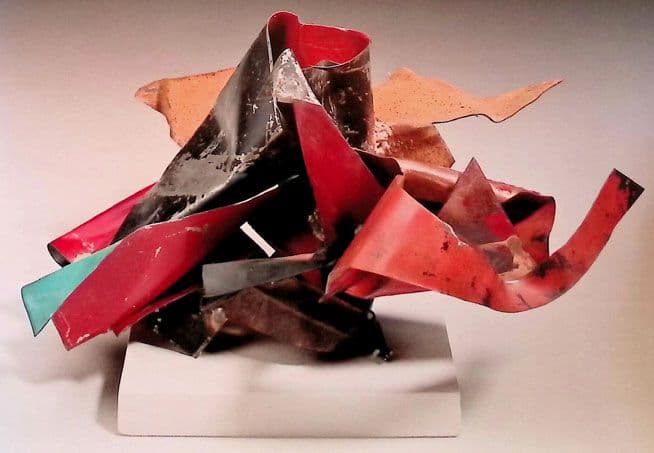
Untitled by John Chamberlain, Year of Christie’s sale: 2014, ©2014 Christie’s Images Limited, © Artists Rights Society (ARS), New York.
"I think one of the things that has been a kind of ongoing theme for the work I’ve been doing all these years is, first of all, a lot of color and also a kind of serious lightheartedness. And I think that’s important. I think art is a serious business, needless to say, but I find it hard to make art that takes itself too seriously."
Richard Kalina: I knew a few of them, but not all that well. And then I’ve always been interested in abstraction, although I started doing realistic paintings after I stopped doing this. I figured, well, I’ll just paint some realist paintings, which I did, but more like portraits, big portraits, and then went from there into integrating them into abstract frameworks, integrating realistic elements into abstract frameworks, and then they became, for many years, more abstract when I was doing collage. If you look on my website, you could see the collage. I’m doing things that look kind of like mosaics because they were done with rice paper, which I had soaked with transparent paint and laid on a gessoed surface, so they kind of glowed. And I did that for quite a while, and then for the last, since 2019, I’ve been working on this series called “Art and Work,” which solves the title problem because I’m up to Art and Work 30 now. And they’re all very crisp paintings. You should probably see some of them back here.
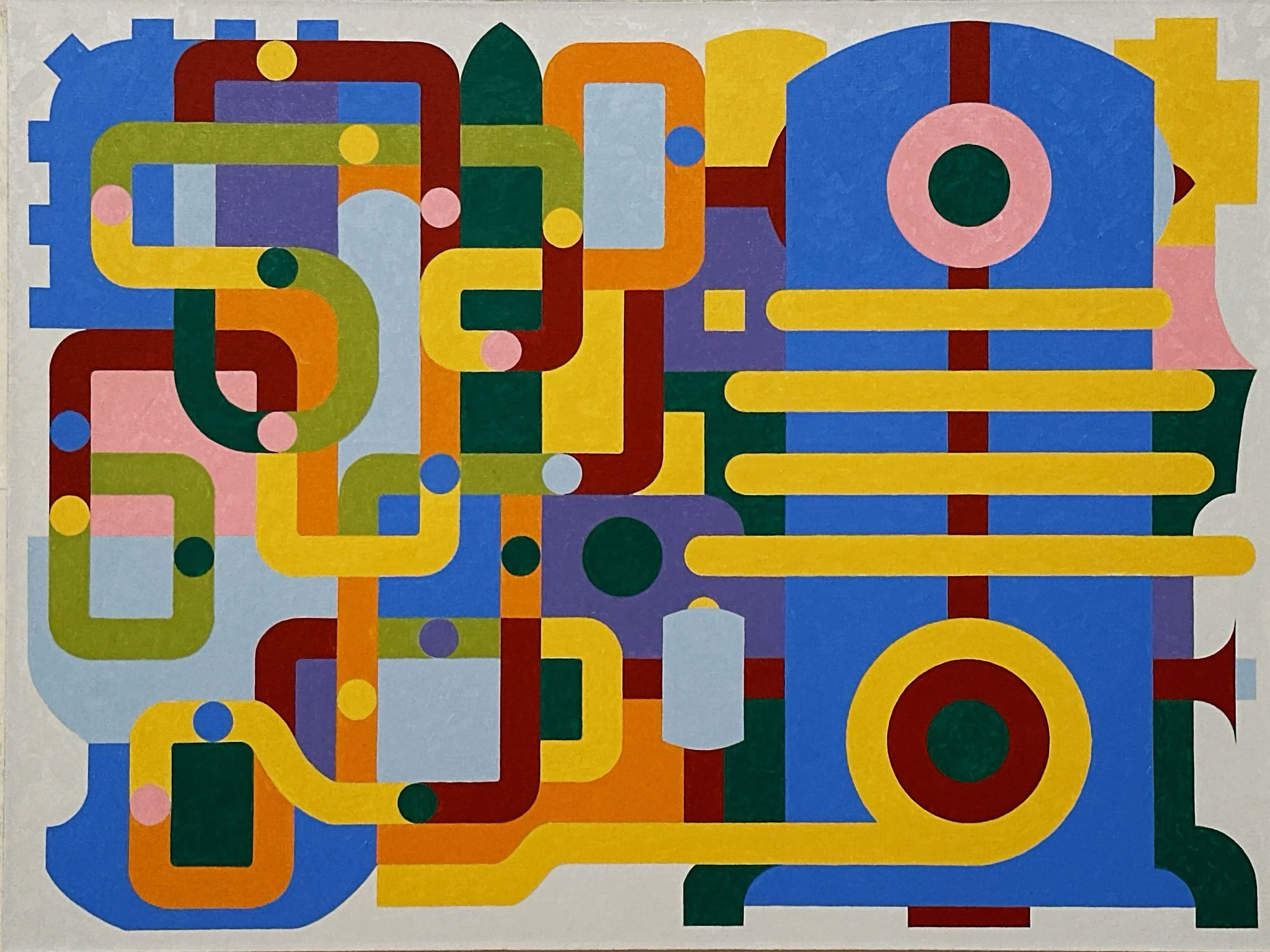
Art and Work 26, 2024, image courtesy of Richard Kalina.
Jared Quinton: Yeah. I can see them pretty well.
Richard Kalina: I can, I’ll give you a look – a Zoom call is a cheap studio visit, isn’t it?
Jared Quinton: Love it. What’s this idea of “Art and Work” about?
Richard Kalina: These are all, you know, hand done, no tape or anything like that, with a bit of surface, because I’m interested in ideas of progress, ideas of the romance of industry, of people, particularly like certain American modernists, I find very interesting, also people like, like Le Corbusier, and Léger. And...
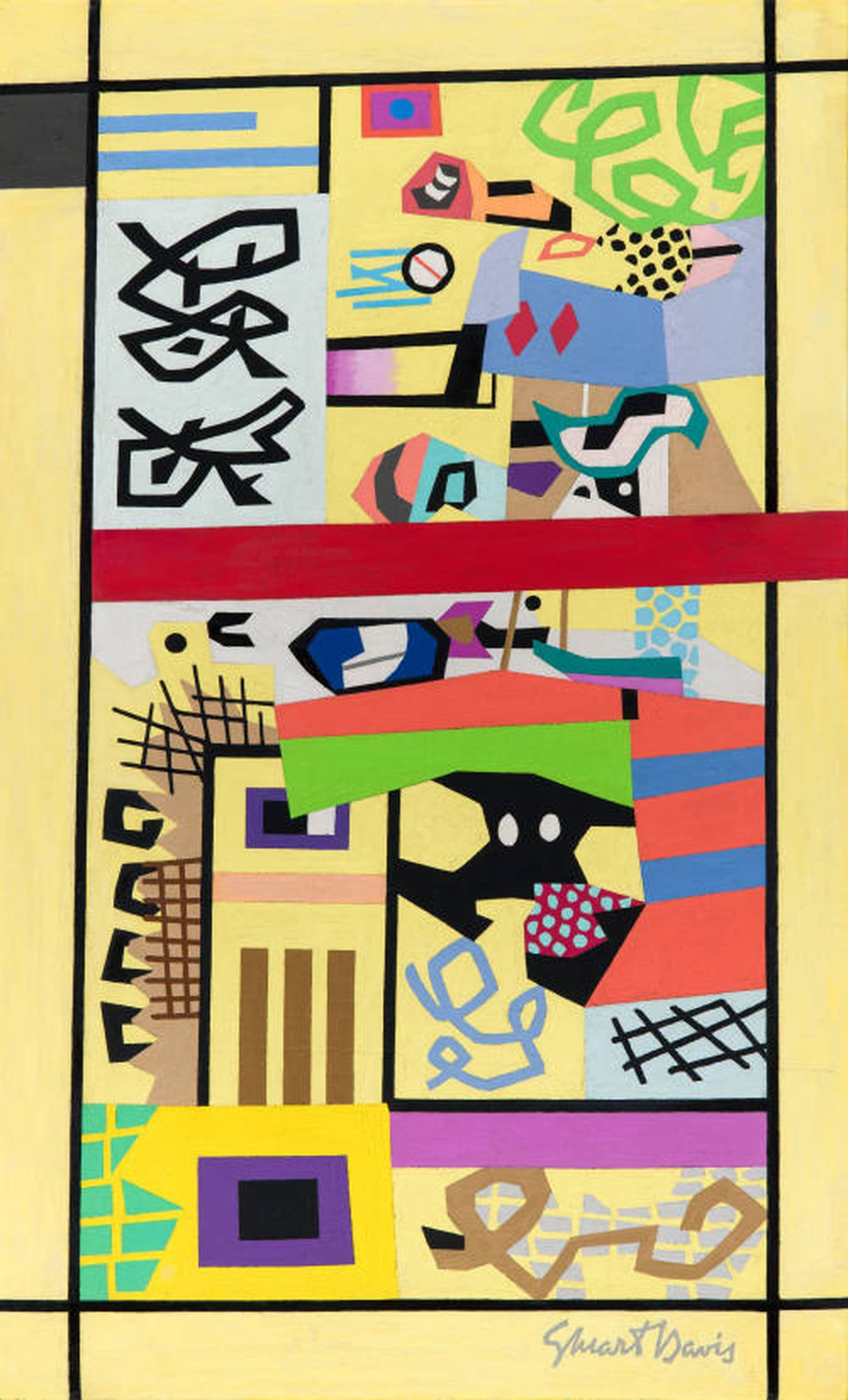
For Internal Use Only by Stuart Davis, Courtesy of Reynolda House Museum of American Art, Winston-Salem, North Carolina, © 2021 Estate of Stuart Davis / Licensed by VAGA at Artists Rights Society (ARS), NY.
Jared Quinton: A little bit of Stuart Davis, maybe?
Richard Kalina: Oh, yes, definitely a little bit of Stuart Davis. Gerald Murphy, all the Park, I particularly like the Park Avenue Cubists. You know, people like Suzy Frelinghuysen and George L.K. Morris. You know, they have a beautiful house, which I went to see, and you should probably go there if you’re interested in this stuff. Beautiful, the Morris Frelinghuysen house is in, like, Stockbridge?
Jared Quinton: Oh, I don’t know about that.
Richard Kalina: Oh, check it out. It’s fantastic. It’s a beautiful house. And it’s full of art. We love, we love our artists’ houses. So in any case, so that’s, that’s what I’ve been doing. There’s a kind of continuity, and I think if you look at this, the new work, it has a kind of complexity and lightheartedness at the same time, which I find fun. So, where shall we go?
Jared Quinton: Can you tell me more about this idea of an artist who’s also a critic? I think in this early period that you’re talking about it’s actually not that uncommon. I mean, people like Donald Judd, for example, are writing tons of criticism.
Richard Kalina: He’s a fantastic critic.
Jared Quinton: So good. But can you tell me a bit about your writing practice and how that came about, and the role it’s played in relation to your artmaking?
Richard Kalina: Absolutely. I started, I can’t believe the time has gone by so, so rapidly, but I think the first piece I published was in 1988 and it was for a show about art and architecture, the craft museum. And then shortly after that, I was asked to write for Arts Magazine. And then shortly after that for Art in America. So, I’ve been basically writing criticism since 1988, which is, gulp, almost 40 years. And I do it regularly. I find it of great interest. It allows me to really focus in and concentrate on things that are related peripherally to my practice, but also of interest and kind of making a larger picture. So I worked mostly for Art in America, where I was a contributing editor for what that’s worth. And then Art in America has changed, like most of the major art magazines, and they’re all sort of owned by one guy. And now Art in America is now a quarterly and it’s like all themed issues. So now I’m writing mostly for the Brooklyn Rail. Writing is just something that I do and I do it regularly. I published two books. The most recent one is, I have it here because I can never remember the title… The Changing Boundaries and Nature of the Modern Art World. That was their idea. And mine was the thing after the colon: The Art Object and the Object of Art, which I thought was much better. Nonetheless, and that was published by Bloomsbury Academic in London, as part of their Aesthetics and Contemporary Art series. It’s a collection of essays that relate to, in some ways, structural aesthetics. And I wrote another book for Routledge somewhat earlier, Imagining the Present: Content, Context and the Role of the Critic. Basically, I collected the critical essays of Lawrence Alloway and wrote a long introductory piece about it. And then also, I’ve been teaching, I’ve been teaching at Fordham University in New York for, this will be my 36th year. And then I taught at Bennington and Yale. So I’ve been, I’m busy.
Jared Quinton: Yeah. Sounds like it.
Richard Kalina: Absolutely. And I make art all the time. So I don’t know. I guess I have some energy to do it. So the whole thing I find really an exciting thing.
Jared Quinton: I have one other question. Since the premise of our talk today is the Tremaine collection, I’m just curious—I’m not exactly wanting to ask how has the market changed over the last 50 years? But I am curious, you know, you’re talking about this time where maybe there weren’t so many big collectors, and you kind of knew who the big collectors were. And so, when the Tremaines bought your work, I imagine that felt meaningful.
Richard Kalina: Yeah. That’s for sure.
Jared Quinton: What is it like now? What is the relationship between artists and collectors now? Has it changed?
Richard Kalina: I think it has. I mean, how do I put it? Collectors, I didn’t really know too many of them. I mean, I’d go to dinners and, you know, they want to have some artists and dinners and because that’s nice. And you would meet people. But collectors, particularly at that time, collectors were in a different socioeconomic class. They were rich and we were all kind of scraping by. Though you would meet them. I had this, of one collector, if you want to call it that, who just died. I was a friend of his, and his family’s for 50 years. He just died. His name was Pehr Gyllenhammar. Pehr was Swedish and was the head of Volvo. And he also, after that, he was a big guy in Rothschild Bank and Reuters. And he was on millions of boards and stuff. And he was a fantastic guy. One of the most interesting guys I knew. And we were good friends for nearly 50 years. He died last year. And through him we’d meet other people like, you know, David Rockefeller and Henry Kissinger or his friends, and Katherine Graham from the Washington Post. And there was a guy named William Rogers, who was Secretary of State. And so, we meet all these people and they were very interesting. And Pehr was very engaged, engaged man, very, very, very smart and very interested in things.
We’d kind of run across people, you know, you’d run across the Sculls [Robert and Ethel Scull], you’d run across those other people or people in California. And then there were other people who would buy stuff, like Florence Barron in Detroit. Sometimes you would meet them in galleries. But you didn’t really hang out with them.
Now, I don’t know. I think art is, I’m not sure the collectors are as... How do I put this? As well-informed. And with as much aesthetic discrimination as they were at the earlier time. I mean, the Tremaines were exemplars of that. They really knew their stuff. And they knew what they were doing. The thing about the critical world, which is in a kind of intermediate place with the world of collectors... Because I was good friends with Irving Sandler. You know who Irving was, right? And also, I’m a good friend with Betsy Baker, who was the former editor of Art in America.
"Now, I don’t know. I think art is, I’m not sure the collectors are as... How do I put this? As well-informed. And with as much aesthetic discrimination as they were at the earlier time. I mean, the Tremaines were exemplars of that. They really knew their stuff. And they knew what they were doing."
Richard Kalina: And I know lots of these people who then have connections with some collectors, because the earlier collectors were extremely well-informed, often enough. They knew what they liked, but they really wanted to expand things. And they were really interested in knowing about art. So, we were friends with the Neumanns. You know Morty and Rose Neumann from Chicago? Oh, you should look at the Morton Neumann collection. It was incredibly important. He had one of the two Rauschenberg paintings, Factum I, Factum II. Panza in Italy had the other one. No, this guy had the best of things. But in any case, the Tremaines stood out as people who were not only extremely knowledgeable, but very prescient.
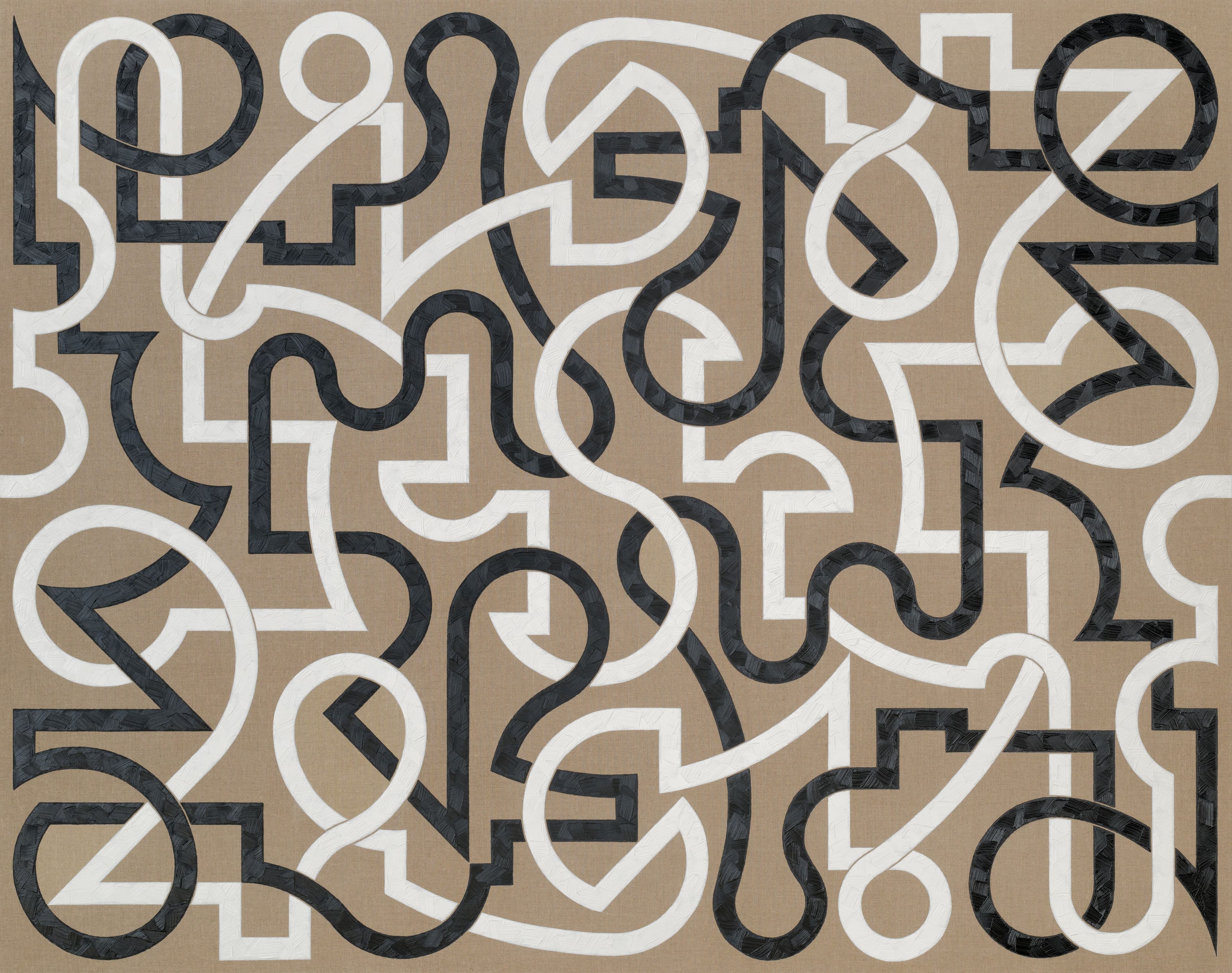
Duetto-2023-66x84 by Valerie Jaudon, © Valerie Jaudon / Artists Rights Society (ARS), New York.
Richard Kalina: And Valerie showed, until they closed, with Sidney Janis. And so Sidney particularly, and then his son Carroll later, were great collectors, as I’m sure you know. And so they had this particular deep, deep understanding and deep commitment to that work and historical understanding of it. I mean, for the Tremaines to buy Victory Boogie Woogie was really important. And I mean, that’s such a key painting. Where is it now?
Jared Quinton: It’s in The Hague. It’s in one of the state museums of the Netherlands. Si Newhouse bought it from Emily and Burton for $11 million. And then the state bought it from him for over $40 million.
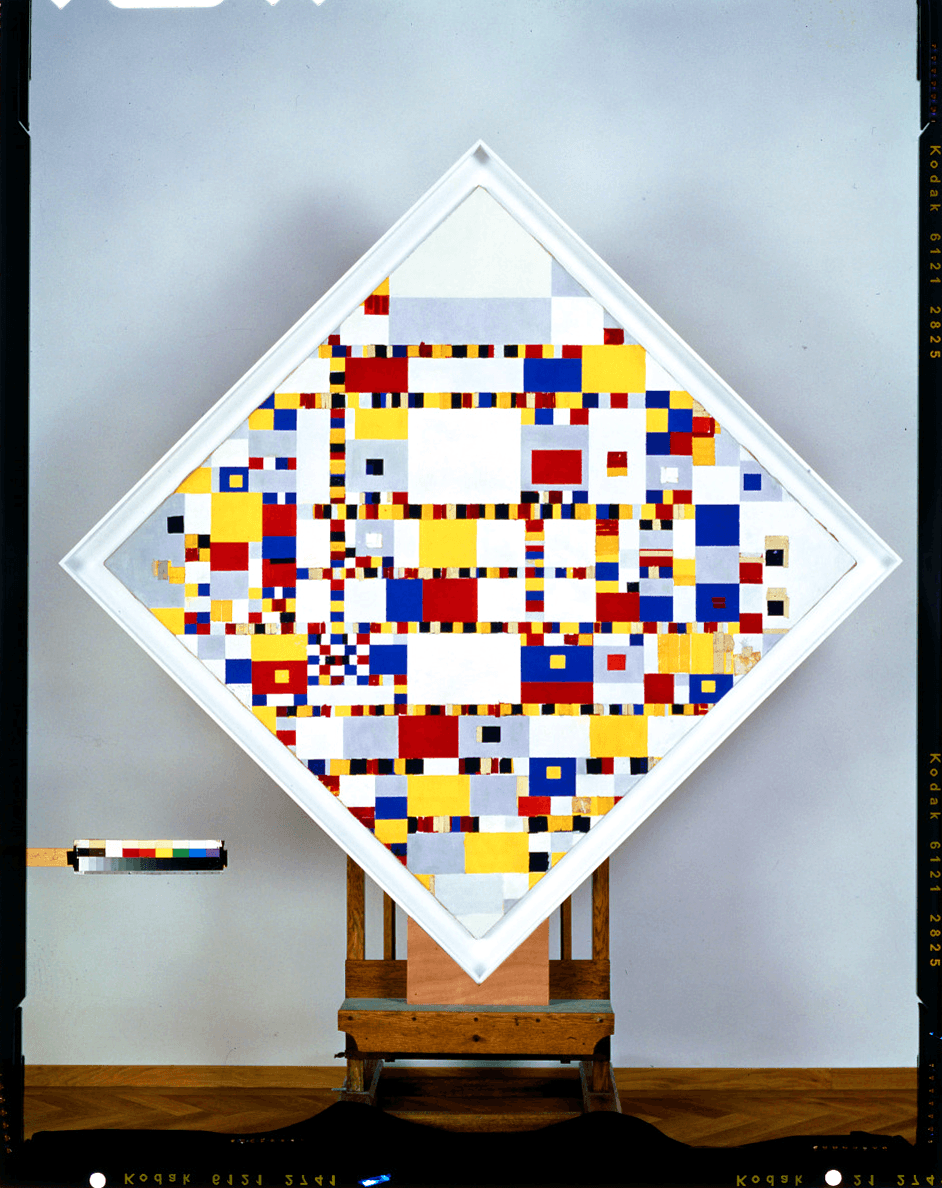
Victory Boogie-Woogie by Piet Mondrian at the home of Emily and Burton Tremaine. Emily Hall Tremaine Papers, Archives of American Art, Smithsonian Institution.
Richard Kalina: Oh, I see. Well, the Janises had a lot of Mondrians, you know.
Jared Quinton: Did they?
Richard Kalina: Oh, God. I think the estate had something like 75 Mondrians.
Jared Quinton: Did you know that Wadsworth was the first American museum to buy a Mondrian?
Richard Kalina: No.
Jared Quinton: And we bought it for like $800. And the board still thought it was way too much money to spend on something so...
Richard Kalina: Crazy and modern. Really?
Jared Quinton: Yeah.
Richard Kalina: No kidding. Well, to get back to your question, there’s so much money involved now. And I think that it distorts things. And it doesn’t seem to me, I may be wrong, but it doesn’t seem to me that those earlier collectors were in it so much for the trophies and for the social prestige. But they were in it because they wanted to make a contribution to understanding. And even though some of them were advised by people, most were often not. I mean, you could take people like the Sculls, for example, who were, shall we say, is there another word for nouveau riche? Somewhat vulgar. But that’s what they were. But they really knew their stuff. They had absolutely fantastic taste. And they had beautiful things. Have you ever seen Painters Painting? It’s basically talking with artists and some collectors. They have Ethel Scull talking about the painting of her portrait by Warhol. That’s a beautiful movie.
But anyway, I think it’s different now. There’s so much more money involved. And the artists are not really calling the shots anymore. It used to be that what ended up filtering into the top galleries and museums were issues that the artists thought were important. And there was a sort of consensus about this. And now it’s not the same. I mean, there’ll be people who are selling for really, really big prices, and I never heard of them. And one of the things I think is even more difficult is that there’s not a clearly delineated path forward in terms of what you’re doing, which I think is important, particularly in painting.
I think we have moved on from an area where artists are defining that which is good. Critics were kind of padding it into place, and now it’s like, well, let’s just find somebody we want to push, and lo and behold, you can push it. I mean, we don’t have to rent our garments about this, but nonetheless, that does seem to be a lot of the way it is.
My feeling is ultimately, it will sort itself out as these things do, you know? And those who are worthy will end up rising to the surface. I wrote an article for The Brooklyn Rail called “The Four Corners of Painting". I argued that there really has not been a new movement in painting or art in general since the late ’80s, early ’90s. It doesn’t mean that things aren’t changing, but it’s like filling in areas or expanding fields. It’s like suddenly you’re looking at a ruler and the distance between a half inch and a quarter inch suddenly expands. And so there’s always lots of different things. So, I find the whole thing to be ultimately encouraging.
Jared Quinton: That’s a beautiful way of thinking of it. That helps me think about my work too as a curator. I feel like being a curator now is not looking for the new thing. It’s sort of like, looking for the artists that are thoughtfully aware of their relationship to art history, to art that’s come before them, and maybe seeking to expand on something in a subtle way, as opposed to feeling like you have to just find the new thing.
Richard Kalina: Jared, you would really like this “Four Corners” piece.
Jared Quinton: I promise I’m going to read it.
Richard, I would love to speak to you all day. But unfortunately, I have to go back to my less exciting tasks. But I just thank you so much for your time and for speaking with me. It’s been such a pleasure.
Richard Kalina: My pleasure, Jared. This was very, very nice.
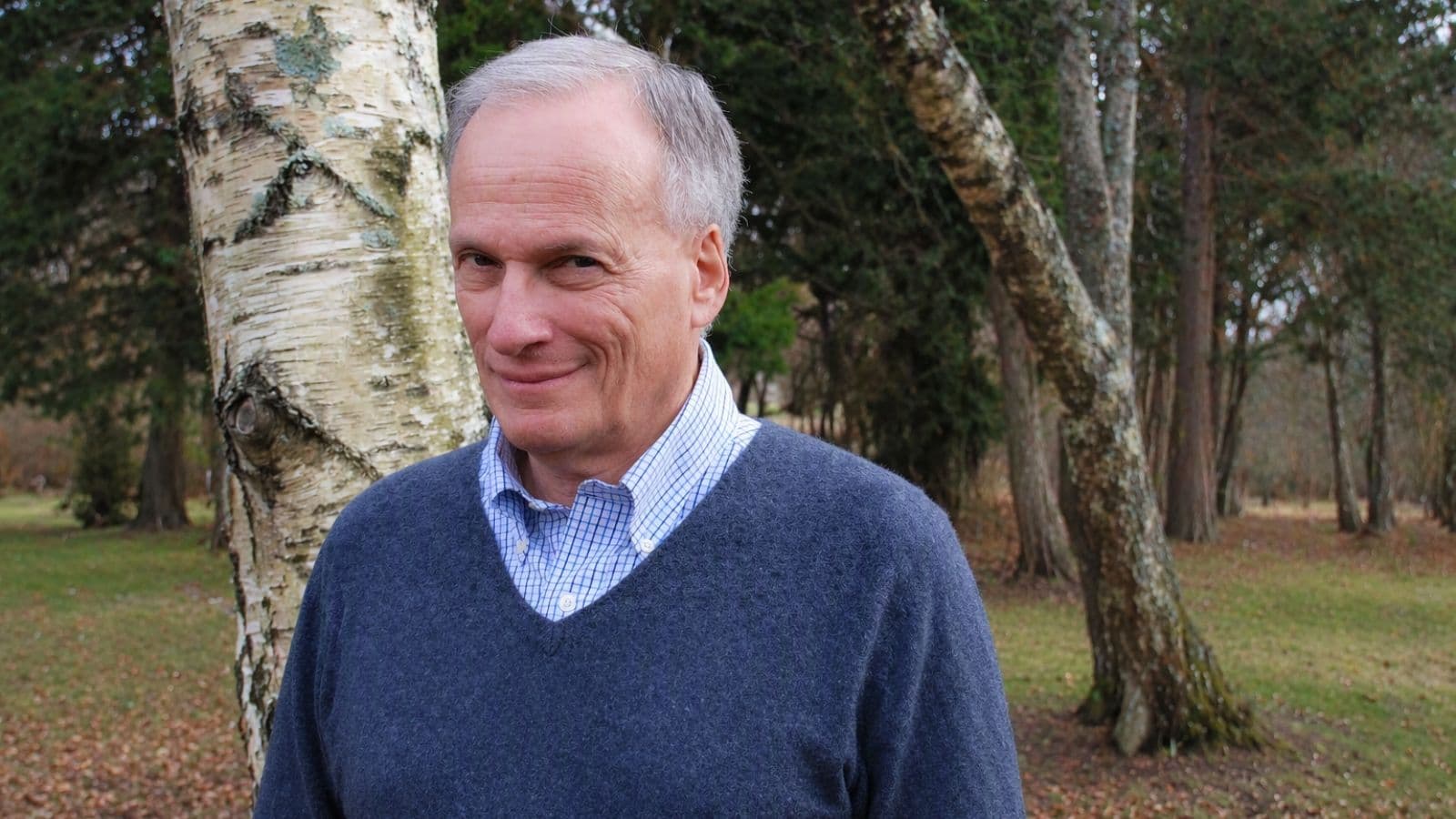
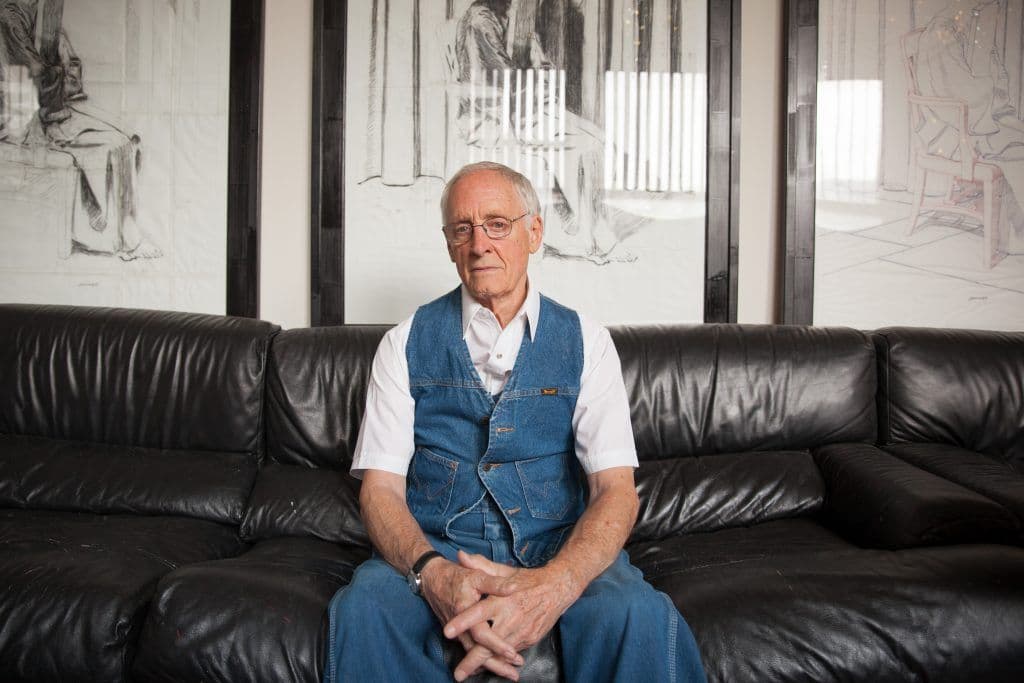
Jared Quinton is an independent curator and writer. He was previously the Emily Hall Tremaine Associate Curator of Contemporary Art at the Wadsworth Atheneum Museum of Art, Hartford, CT. Cover image: Richard Kalina, photo by Valerie Jaudon.
From the Archives
From the Archives
Explore More Stories
Creating Impact
The Emily Hall Tremaine Foundation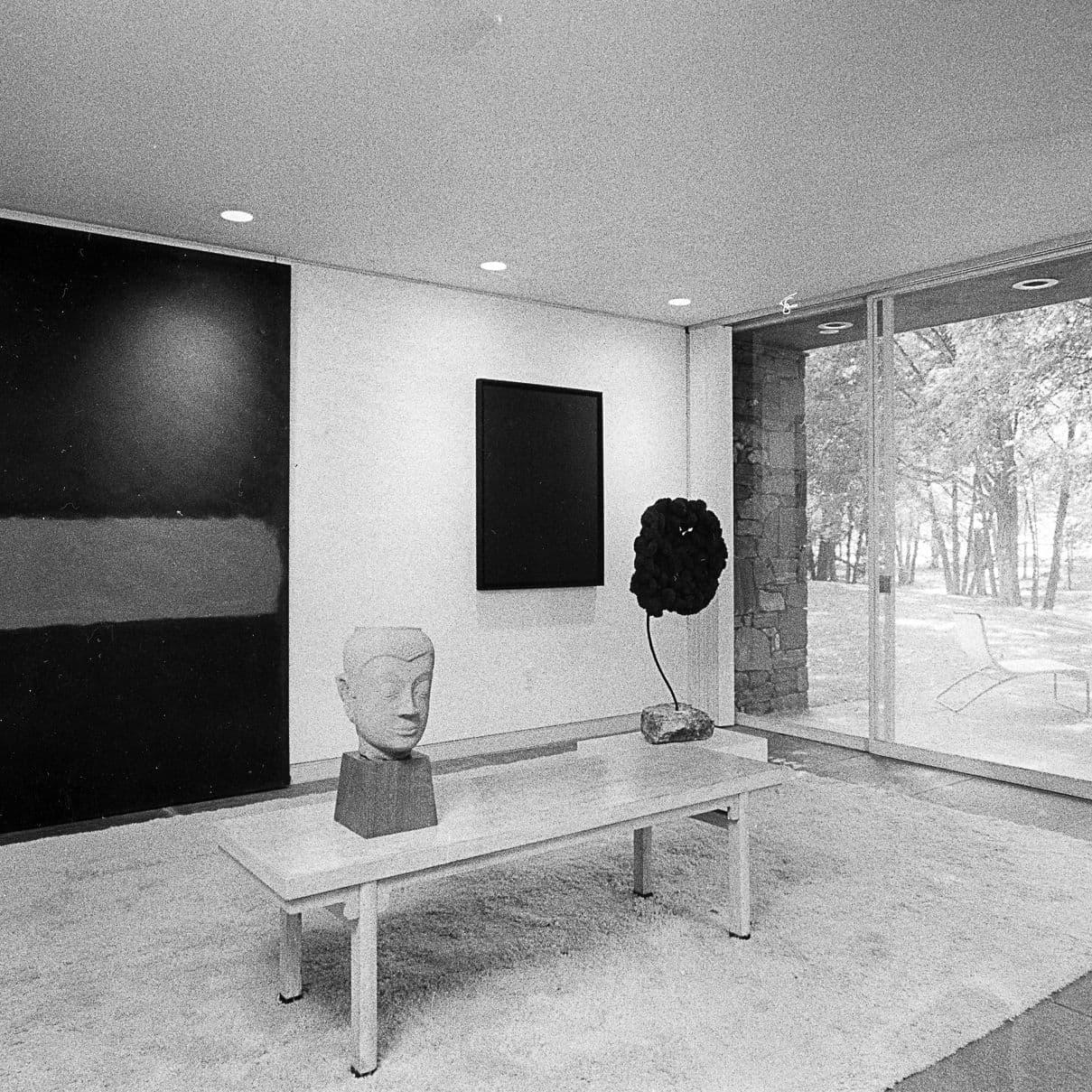
Established in 1987 by Emily Hall Tremaine, the foundation seeks and funds innovative projects that advance solutions to basic and enduring problems. With an overall emphasis on education, principally in the United States, it contributes in three major areas: the Arts, Environment, and Learning Differences.