
Story
Larry Poons: Insights from
the Mind of an Artist
The following interview with Larry Poons was conducted and transcribed by Kathleen Housley on August 25, 2025.
Housley: Emily Hall Tremaine liked to visit artists in their studios to see what they were working on. As she expressed it, she wanted “to see what was coming through the artist.” She was interested in the process of creation. Did she visit you in your studio?
Poons: I don’t think so. I think we first met at the Green Gallery through Dick Bellemy. We talked about Mondrian.
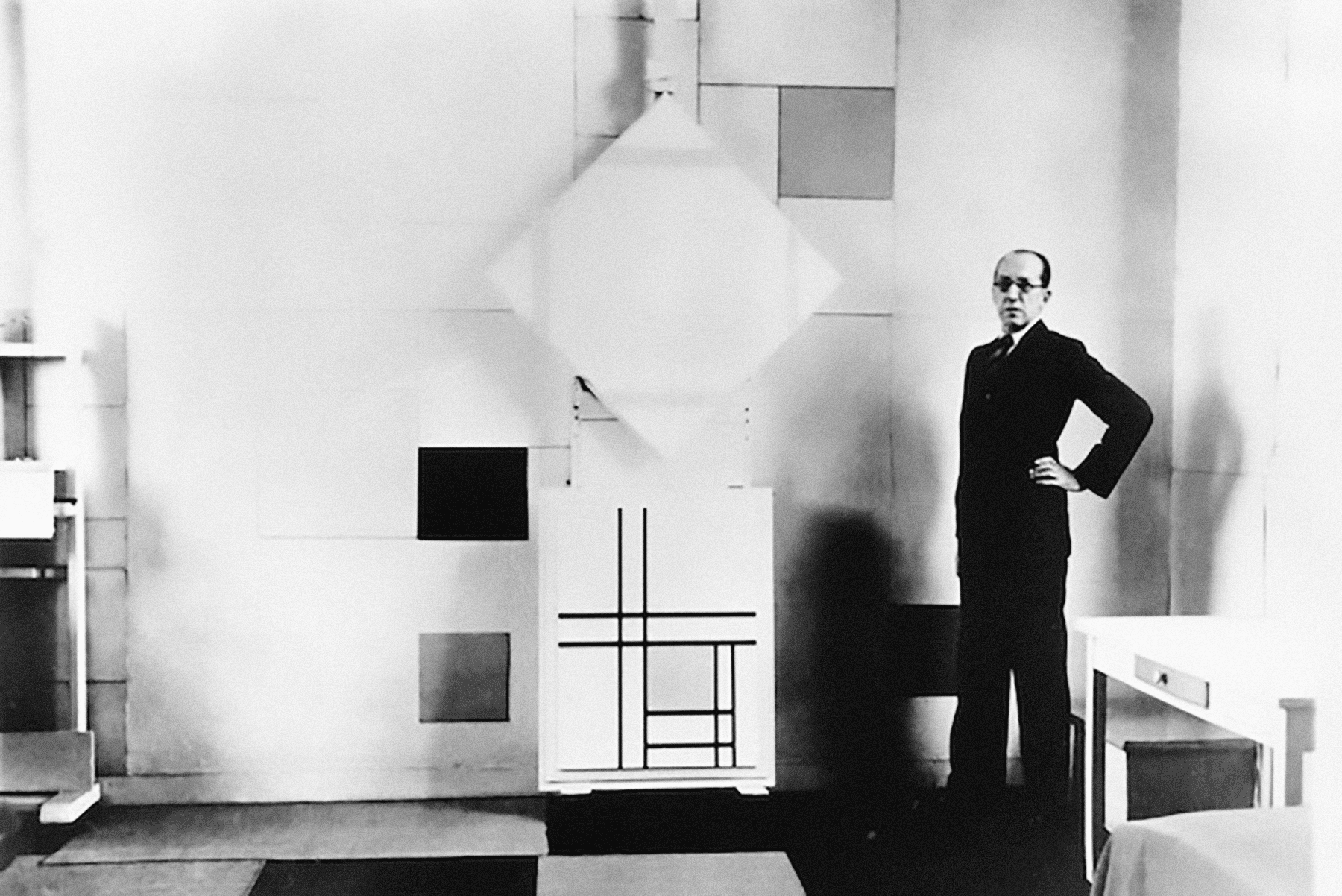
Piet Mondrian in his studio with (top) Lozenge Composition with Four Yellow Lines (1933) and (bottom) Composition with Double Lines and Yellow (1934), Paris, October 1933, © Charles Karsten via Het Nieuwe Instituut
Housley: Did you see the Tremaine collection in Madison or Manhattan?
Poons: No, I never visited them. But on the question about what comes through the artist: we are picking up messages. We are part of an electrical system. So, from the very beginning in the womb, we’re picking up sounds. We don’t know it is a sound. We don’t know what it is. Our brain does not even function at that level at that time, but we still hear things. You’re not in dead silence from the moment you are born. Perhaps in a technical sense they’ll find out one day. Mozart wasn’t concentrating on what he heard, what he picked up. He couldn’t be aware in his mother’s womb. How could he be? His sensing apparatus, if you want to call it that, was picking up all of that and stored in a visual memory or an aural memory—all the possibilities that exist on which our systems are built.
Housley: People used to say Tremaine had a “real visual intelligence.” Does this relate to what you are saying?
Poons: I wouldn’t say so. We are aware of sound, of touch, of feel, and smell. They all go any way that a person’s imagination takes them. Someone coughing in a corner can trigger a complete novel—like eating the cookie, the Frenchman Proust got the whole inspiration by just a smell that attracted him. Everything did not happen all at once, but he was moved by the experience of a smell or a sound.
“Mondrian, from the word go, was a gifted painter. I mean, his early paintings of flowers are gorgeous. They just simply were. When he would paint a painting, his hand was there. You know, it’s hard to put into words. It's like why Mozart is different from Beethoven, or why it's not the same.“
Poons: Mondrian, from the word go, was a gifted painter. I mean, his early paintings of flowers are gorgeous. They just simply were. When he would paint a painting, his hand was there. You know, it’s hard to put into words. It's like why Mozart is different from Beethoven, or why it's not the same. There was a period when Beethoven, Mozart and Haydn – you couldn’t tell whose piece you were listening to because they all sounded very much similar, not the same, but similar on a musical level. If you didn’t know the piece, you could say it’s one of the three. And that is God-organized. Beethoven didn’t become popular until the 20th century. He was recognized but he was not as popular as many other people of that time. You can hear it for yourself. In the 20th century that’s when his music really became popular. I don’t know why I’m saying that, but it’s just the way things work over time. We don’t live long enough to get an absolute reading on what is, or was, not so good until 200 years, but you won’t be alive to know it anyway, But that’s the way it is. Salieri was much more popular than the young Mozart. Hell, he was the court musician. We don’t live long enough to get an accurate reading on what, not who, is outstanding. It’s impossible. You can’t have a market without that being put in there. Why do you want to buy that picture?
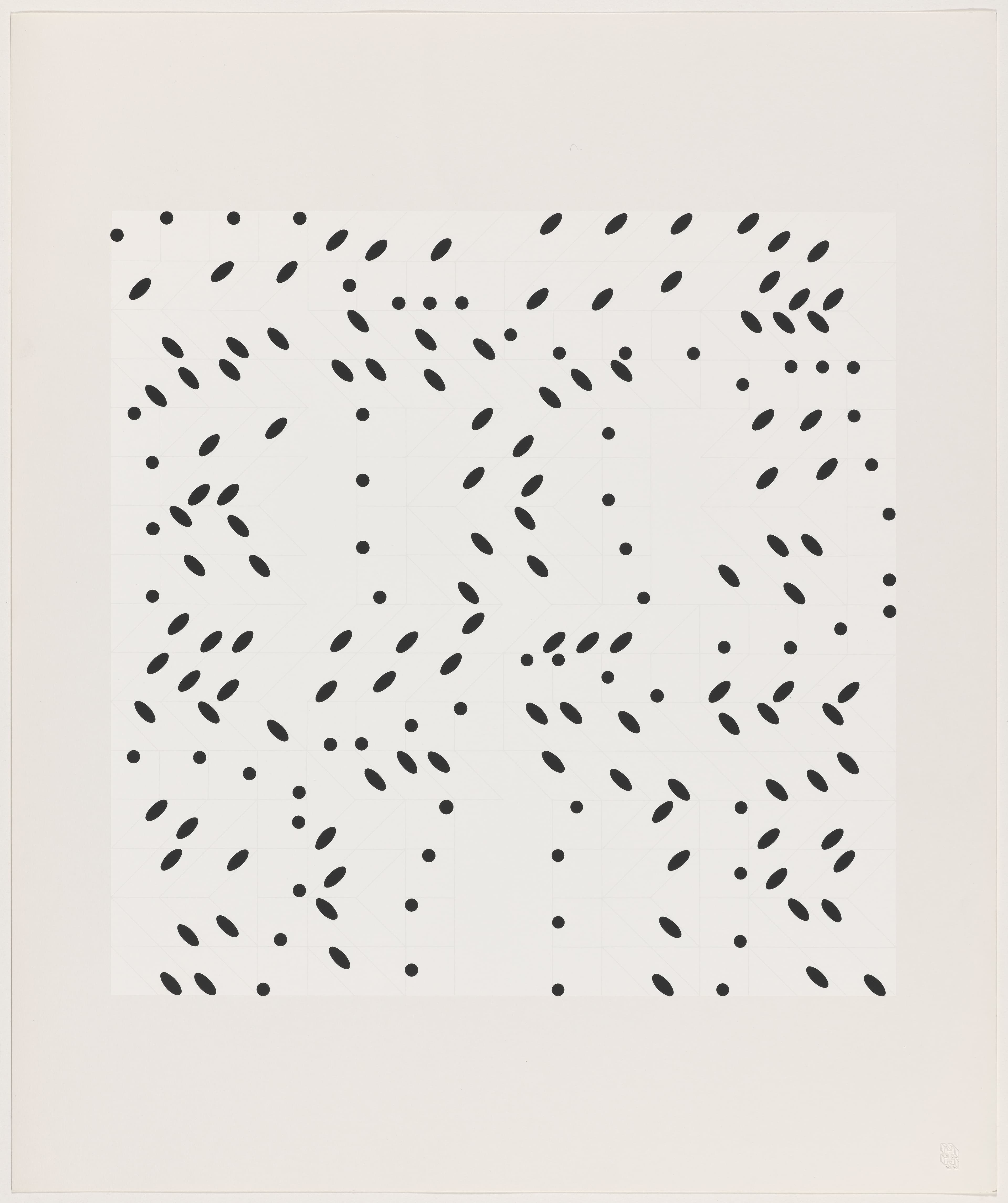
Untitled, 1964 by Larry Poons, National Gallery of Art, © Artists Rights Society (ARS), New York
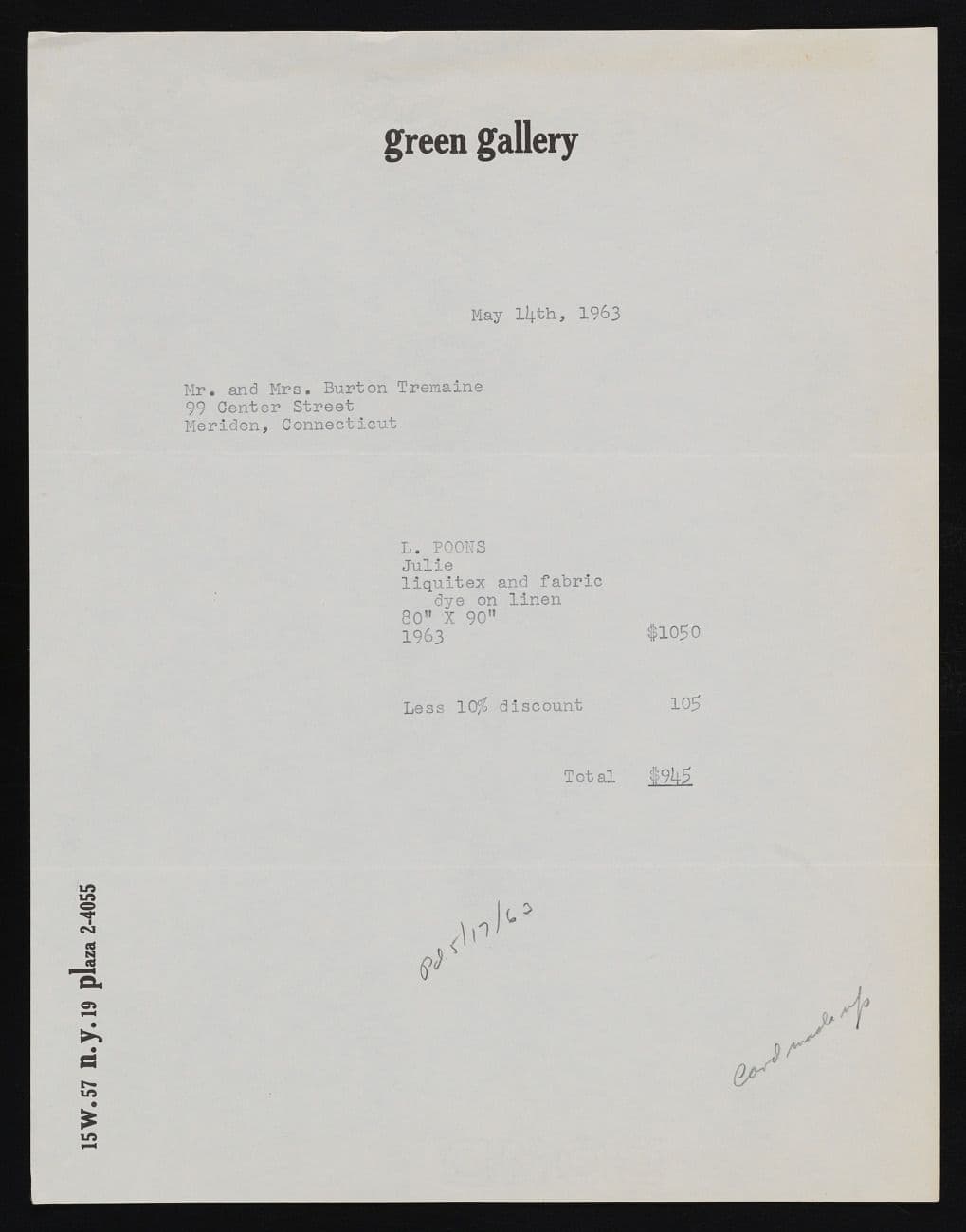
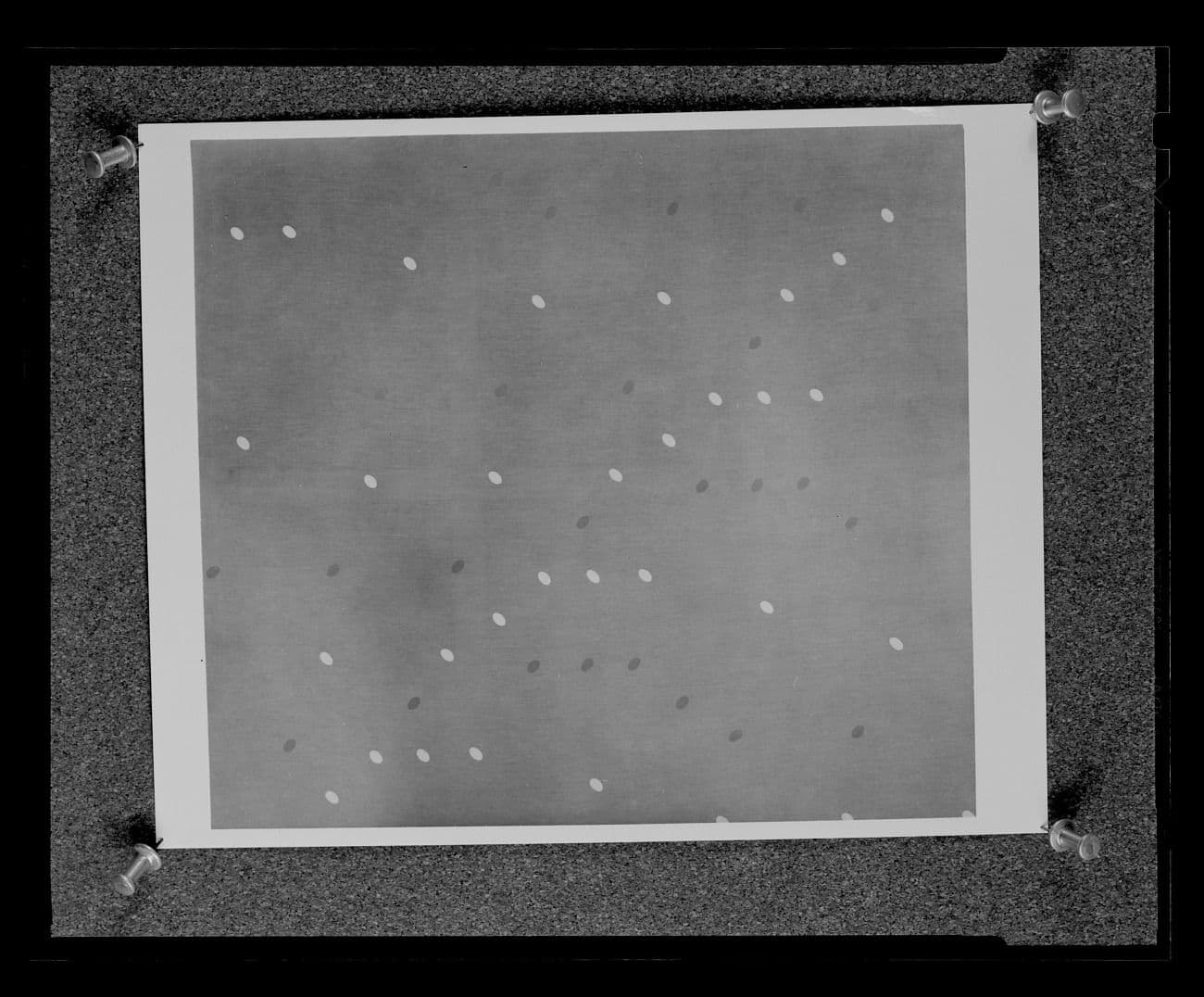
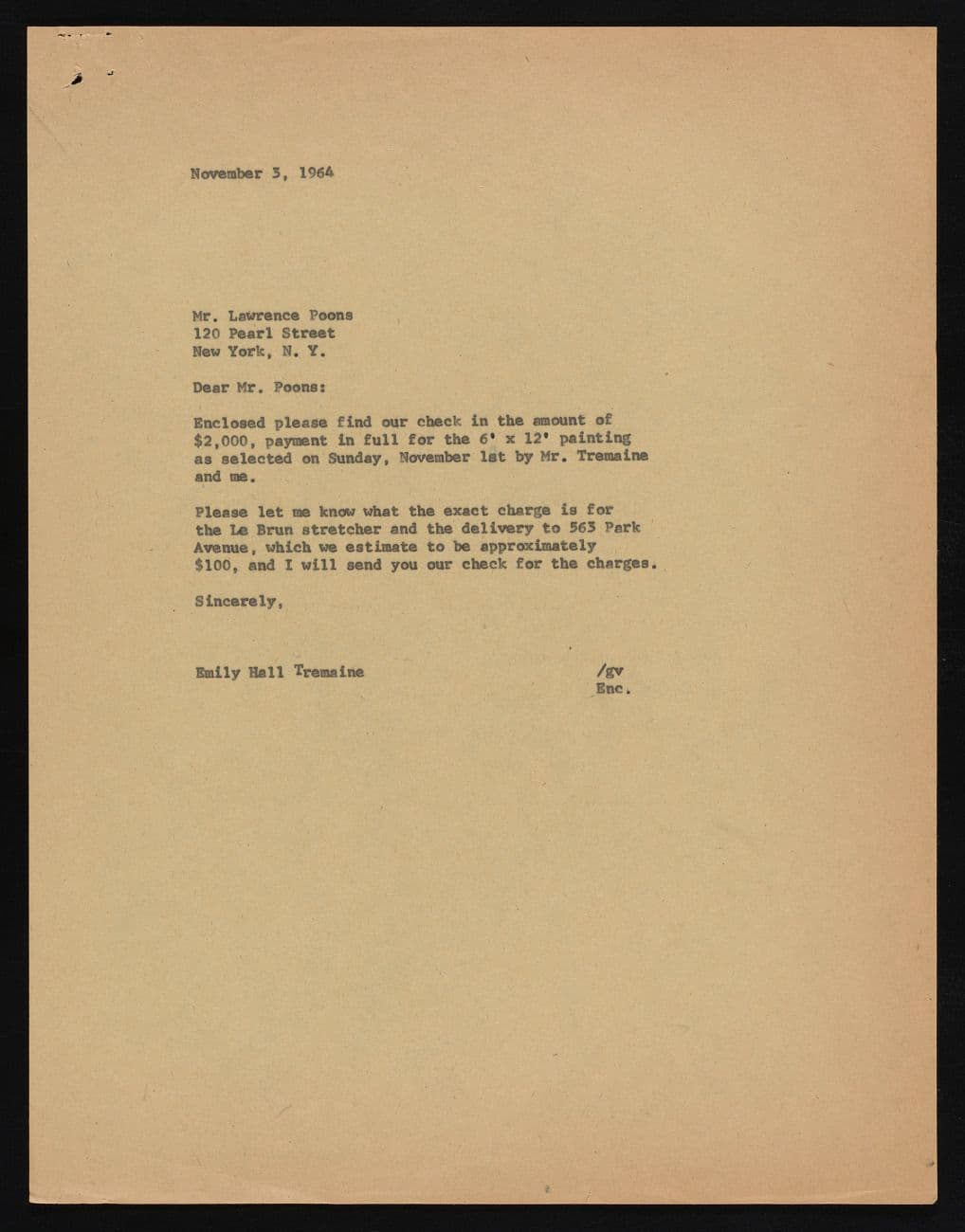
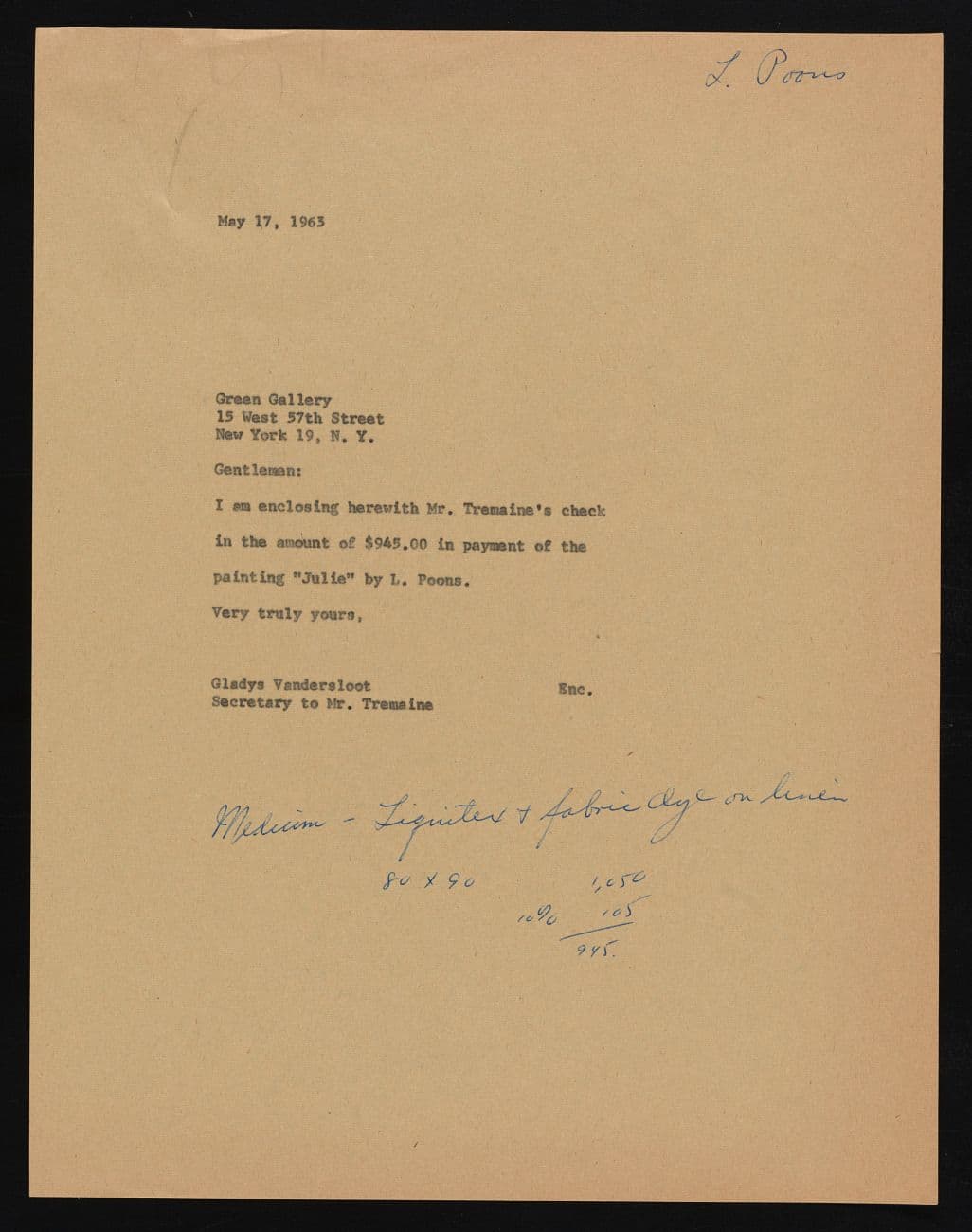
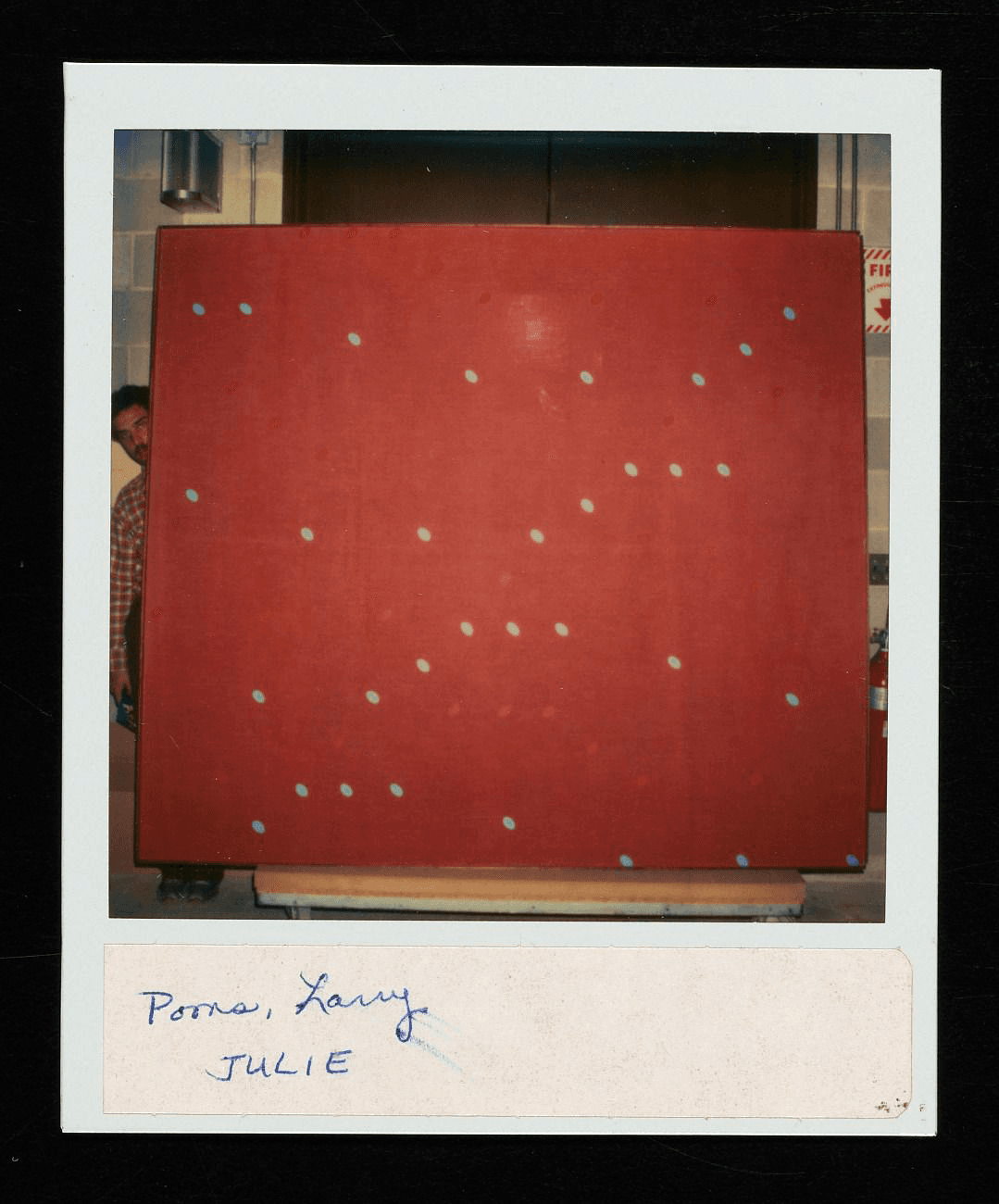
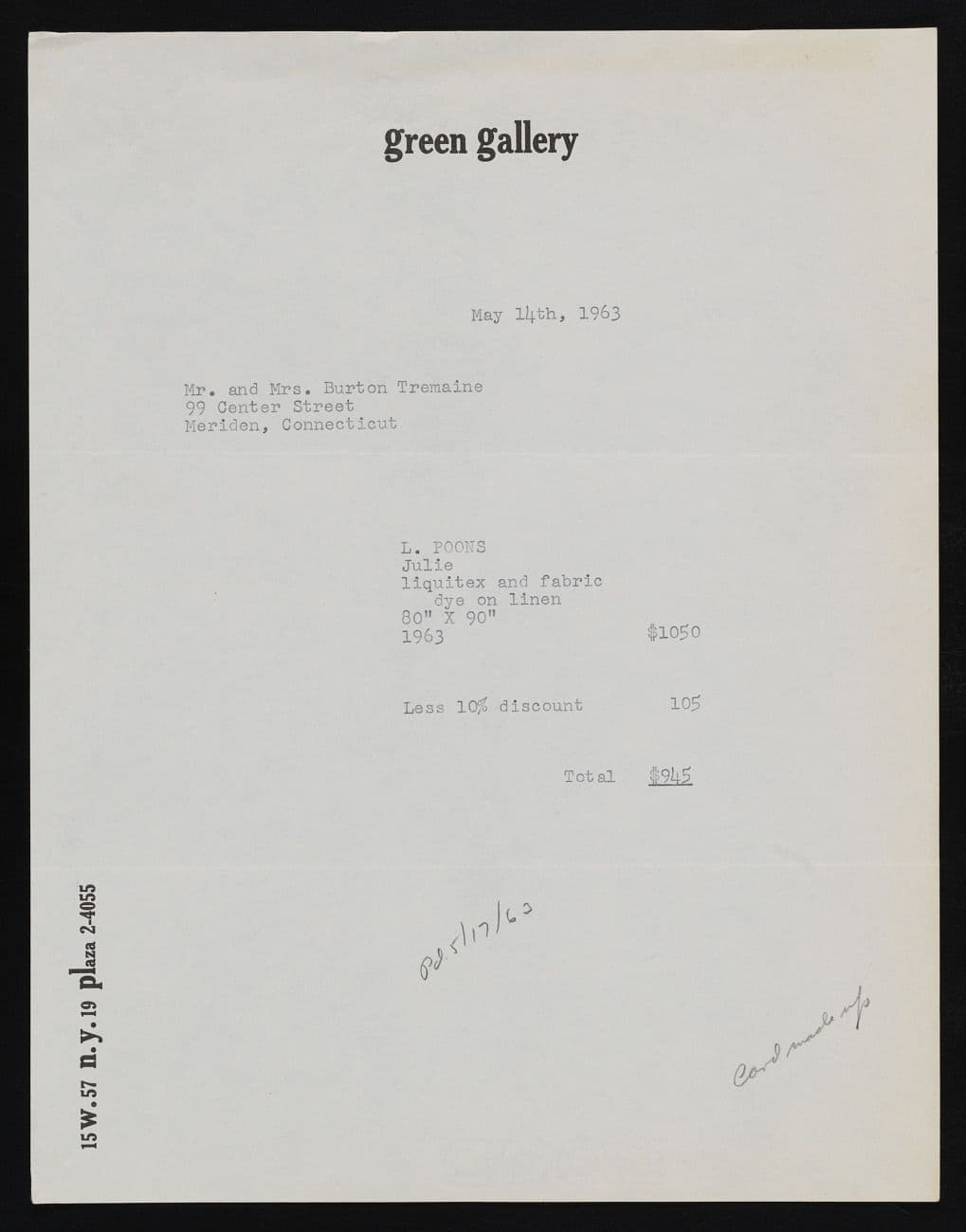
“But I think in the case of her liking Julie, at the moment that painting was painted, it was really chancy. It wasn’t like the previous dot pictures. That's all I can say. And she picked it out and that always impressed me, that at least so far as I was concerned, she picked out a difficult one. It might have been the only one available because there weren’t that many of those pictures back then. It could have gone either way, but it was a good choice for her.”
Poons: But I think in the case of her liking Julie , at the moment that painting was painted, it was really chancy. It wasn’t like the previous dot pictures. That's all I can say. And she picked it out and that always impressed me, that at least so far as I was concerned, she picked out a difficult one. It might have been the only one available because there weren’t that many of those pictures back then. It could have gone either way, but it was a good choice for her. It was not the Enforcer-type of picture (Ed. note: Enforcer was the title of a painting by Poons). It was more like a regular painting. But they are all like regular paintings, I hope. But she might have got it because it was the only one available. But I think she actually liked it.
Housley: She did like it.
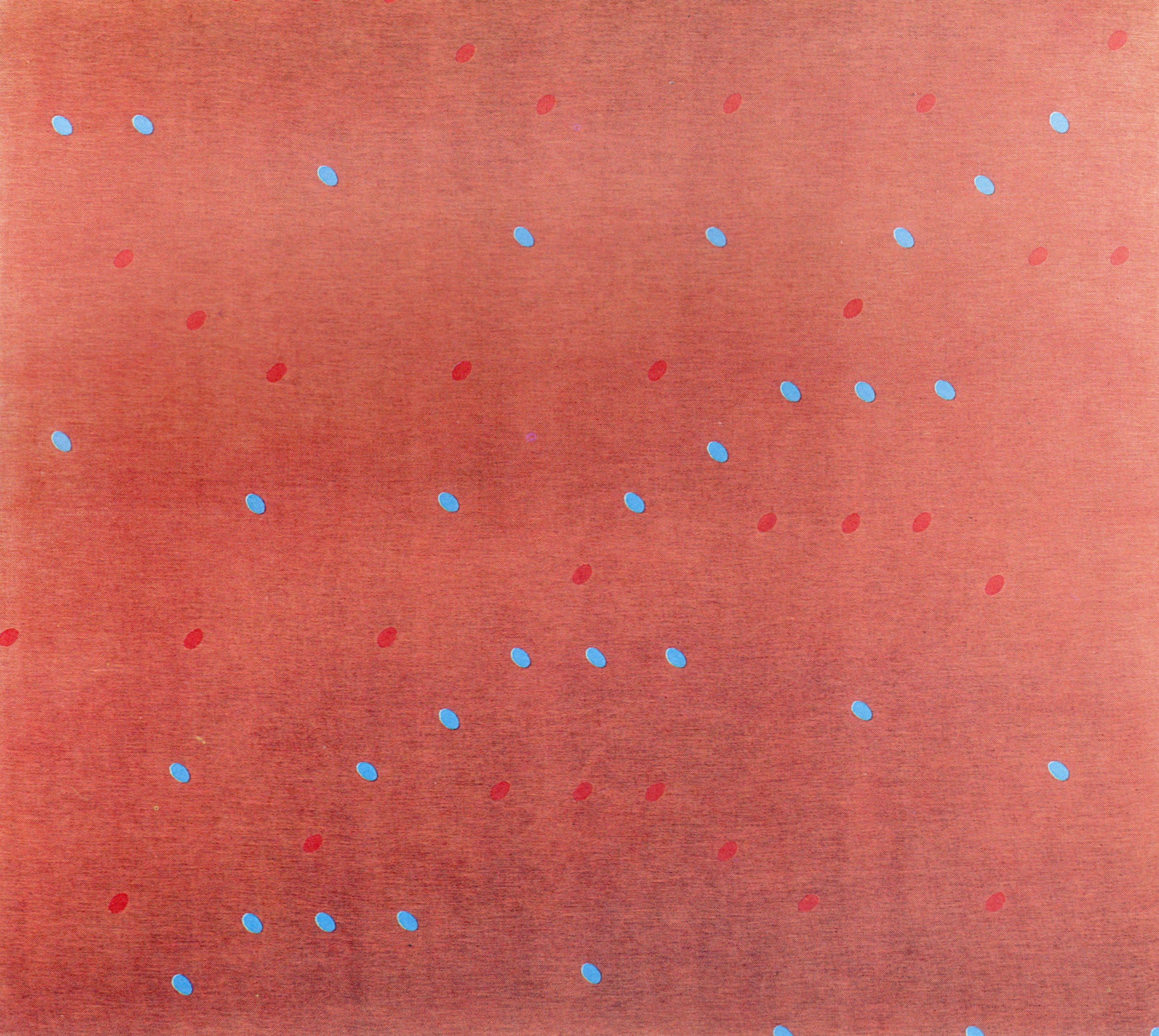
Julie displayed in the Tremaines' living room.
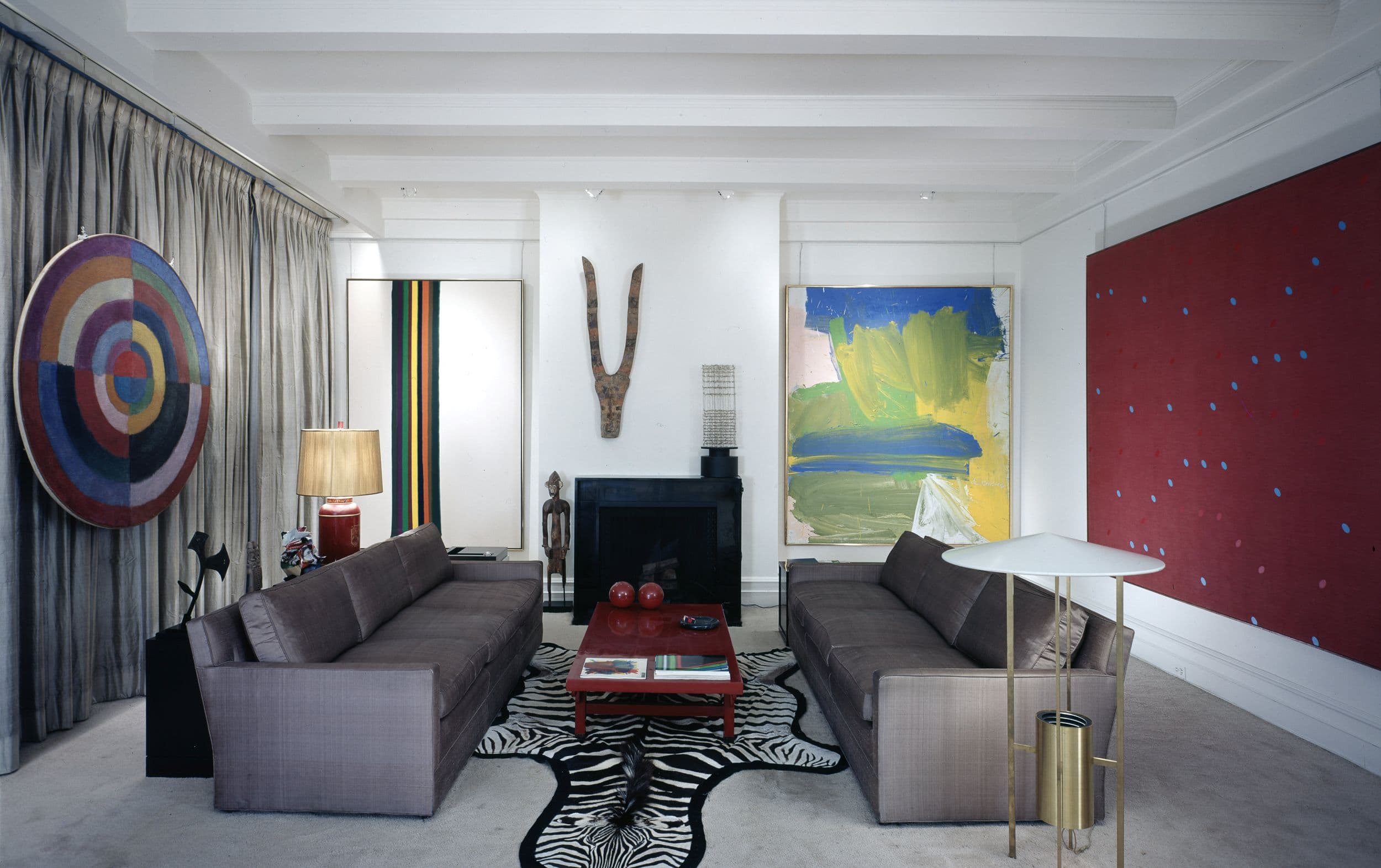
Background image: The Tremaines' NYC living room, from left to right: Le premier disque by Robert Delaunay on the curtain, 1-33 by Morris Lewis to the left of the fireplace, Villa Borghese by Willem de Kooning to the right of the fireplace, Julie by Larry Poons to the extreme right, © Artists Rights Society (ARS), New York. Foreground image: Julie by Larry Poons, The Tremaine Collection: 20th Century Masters: The Spirit of Modernism, Hartford, Conn: Wadsworth Atheneum, 1984 © Artists Rights Society (ARS), New York.
Poons: That’s what I mean. That you’ve picked up what other people have published. That she liked that picture of Poons – without a lot of words. When we talked, I can understand why she appreciated my carrying on about what the relationship was with Mondrian and the boogie-woogie paintings. Those things, they bounce around, they move, and the dot pictures move. They move too. Rembrandt moves. Anything that is good moves. There’s no such thing as static. Mondrian’s paintings in our time have been cracking because he had to paint in oil paint, so being the artist that he was, the painter that he was, the human being that he was, he couldn’t wait long enough to change the damn thing once he decided what it needed. As soon as he could get some more paint, or color or shape changed in a painting, he painted over it and he didn’t let it fully dry. So that’s why they cracked. He wanted to paint. He didn’t want to sit around and watch the grass grow. So he painted wet over damp, which you can’t do with oil paint because it will crack. So that’s the painterly urge that Mondrian had. His early paintings don’t stand still. He had to adjust them until they felt right just like a nude. You have to do it until it feels right and looks right. Looking right and feeling right is the same thing. I think Emily either initially really liked Julie. Maybe initially it was the only Poons available. I have no idea. Either way she grew to really like it, that’s what it sounds like, which speaks that she was sensitive to paint, or not. With that painting, she was, which is documented for us. She went a lot of places with this collection.
“When we talked, I can understand why she appreciated my carrying on about what the relationship was with Mondrian and the boogie-woogie paintings. Those things, they bounce around, they move, and the dot pictures move. They move too. Rembrandt moves."
From the Archives
From the Archives
Housley: Mondrian was a bedrock to the entire collection.
She owned Victory Boogie-Woogie.
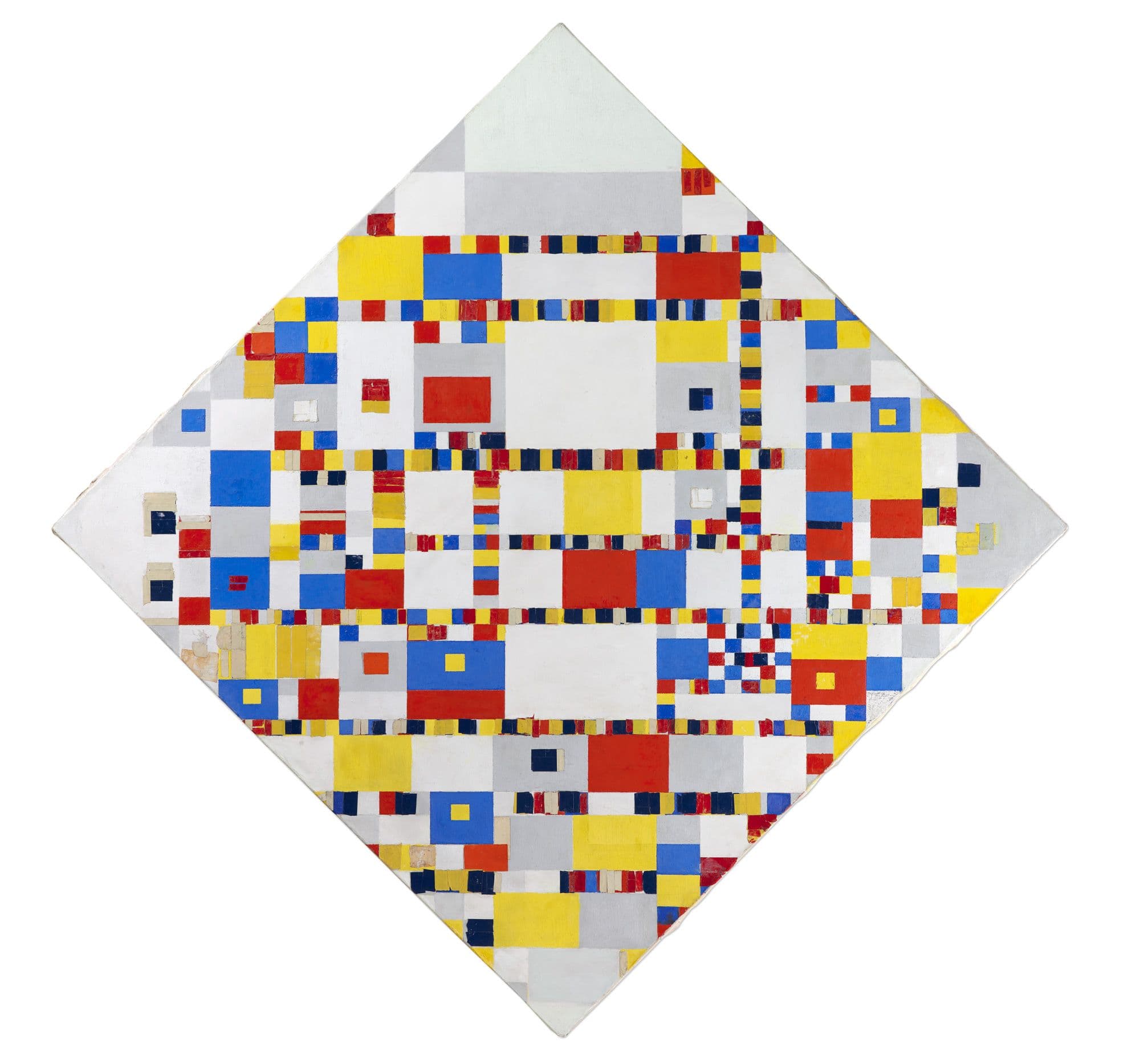
Piet Mondrian, Victory Boogie-Woogie,1943-1944, Kunstmuseum Den Haag, long-term loan Cultural Heritage Agency of the Netherlands / Ministry of Education, Culture and Science
Poons: The diamond painting—it was unfinished. But what are you going to do? He’s dead. He used tape so he wouldn’t have to keep painting over it and have it crack to hell. Also, it was quicker. He didn’t have to wait for it to dry, which was great. It showed you how much he wanted to dance or move all his life. When he used to live in Holland, it’s documented in one of the books I read in the library at the Boston Museum School, which was the only good thing about the school was the library, and I read in one book when Mondrian gave up on something and discarded a painting, he decided it wasn’t finished or just didn’t want anymore, he used to take it out in the backyard and shot it with a pistol. He used it for target practice. People think, “look at Mondrian, he’s not the type of person that would do that – coat, tie and everything, very neat.” That’s what people misrepresent for themselves and what they’re talking about that’s important.
"What’s important with any artist is how good their art is. And good is – define good – define what’s good in music, in literature, in poetry. For one reason or another, Emily picked out that painting Julie, which I think is going into a retrospective they're working on, which is going to be in the show that they put together. Which I was happy about. It finally resurfaced, I didn’t know she had the painting, but it moved around through many collectors. Until in my recent time, it was found. I’d given up on where it had gone or what had happened to it."
Poons: What’s important with any artist is how good their art is. And good is – define good – define what’s good in music, in literature, in poetry. For one reason or another, Emily picked out that painting Julie, which I think is going into a retrospective they're working on, which is going to be in the show that they put together. Which I was happy about. It finally resurfaced, I didn’t know she had the painting, but it moved around through many collectors. Until in my recent time, it was found. I’d given up on where it had gone or what had happened to it.
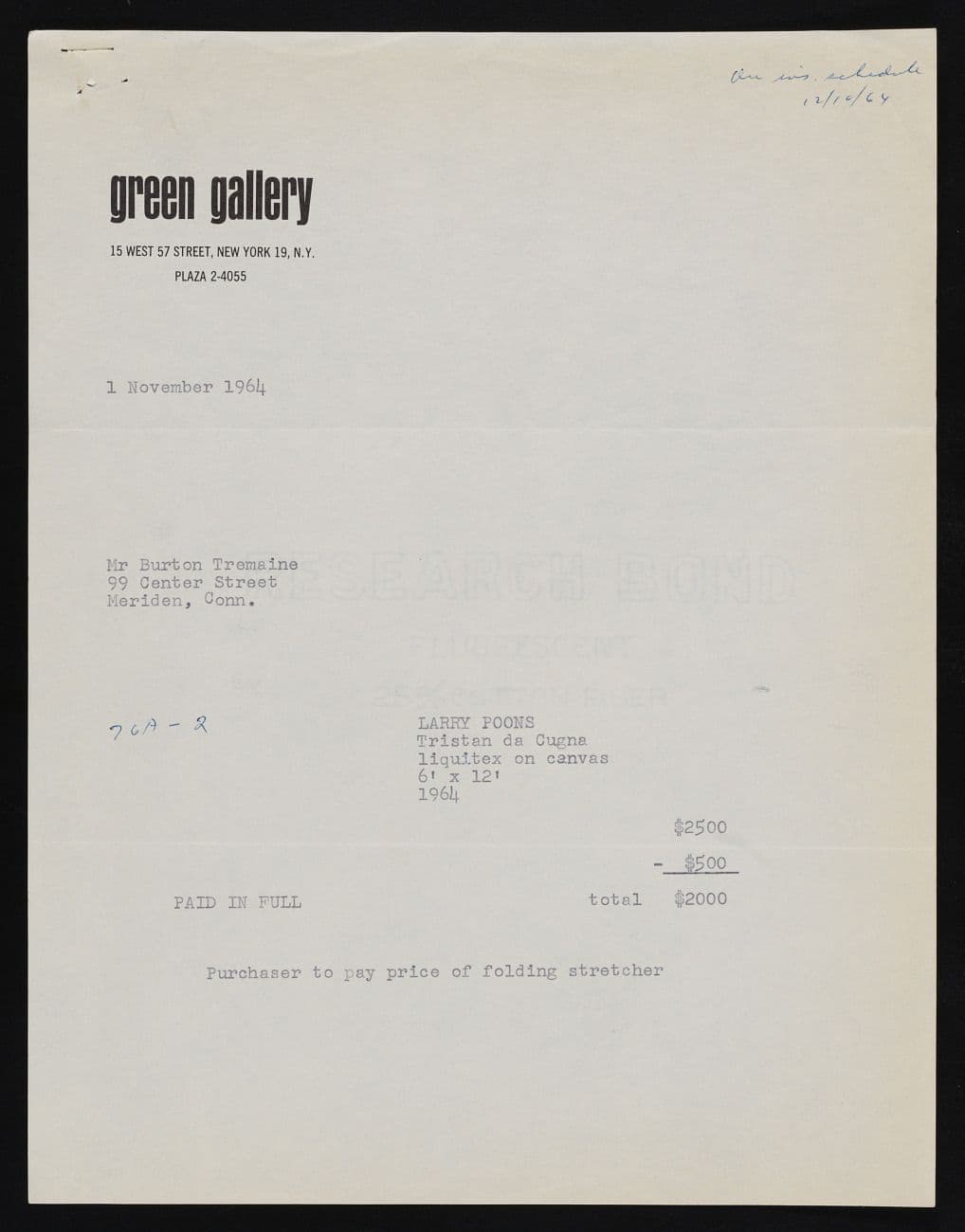
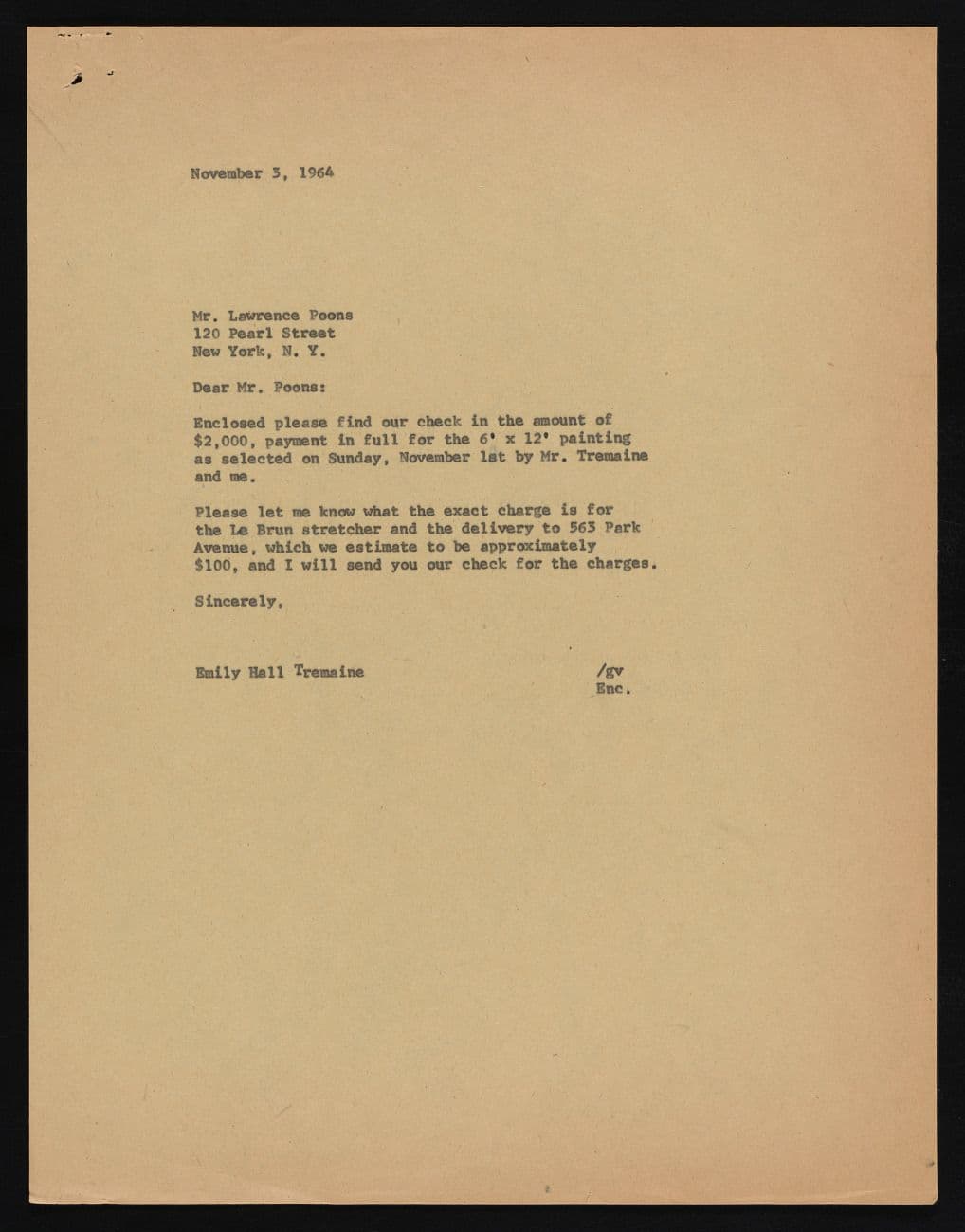
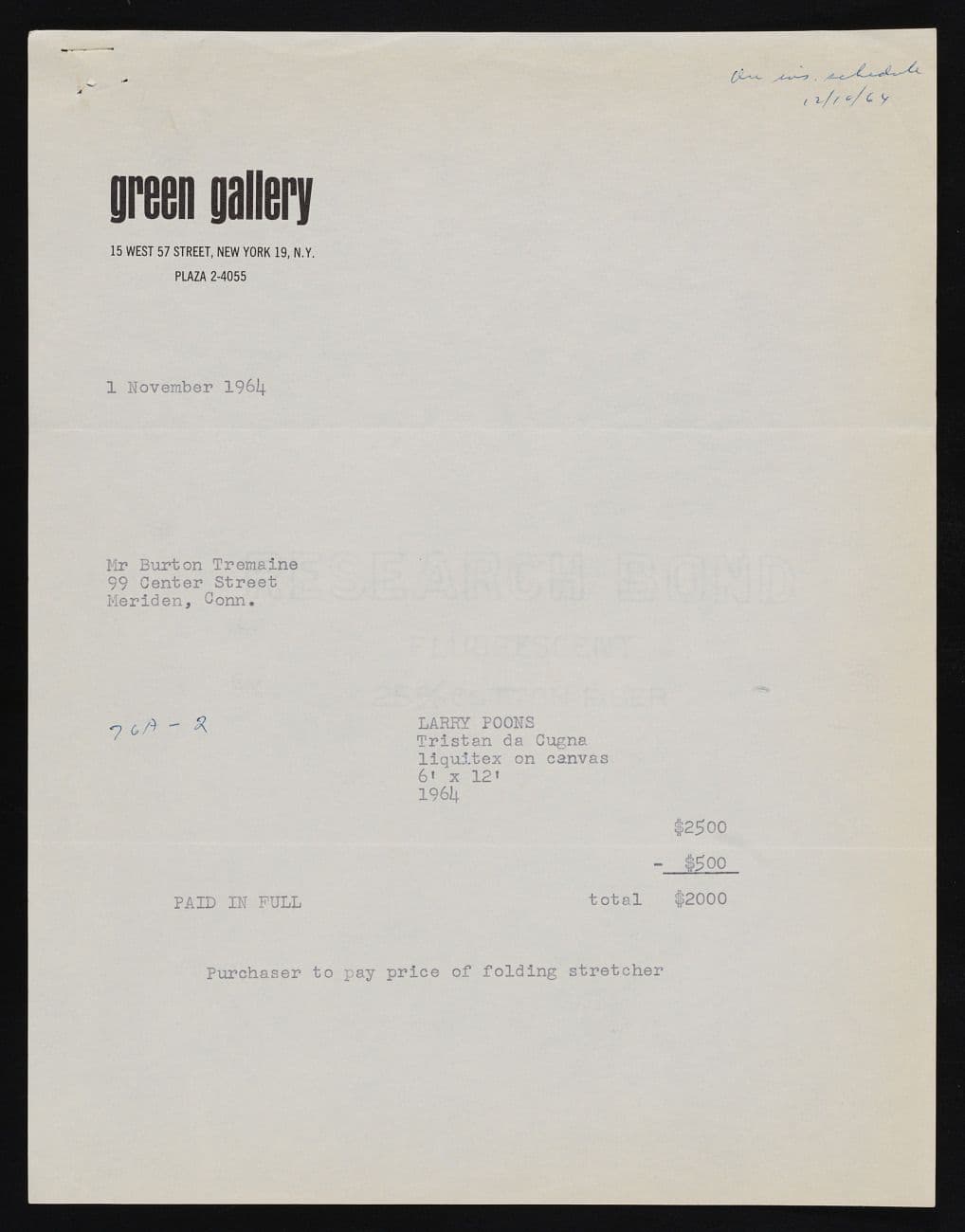
Housley: The Tremaines also acquired Tristan da Cugna. Do you remember about that?
Poons: The title came from Carl Andre or Hollis Fenten, my friends at the time. They used to name my paintings, gave them their titles. That was the mountains in Mexico. It’s a good one. She got another good one.
Housley: She donated it to the National Gallery of Art.
Poons: I’m indebted to her memory.

Larry Poons, Tristan Da Cugna, 1964, National Gallery of Art, © Artists Rights Society (ARS), New York
Kathleen L. Housley is the author of eleven acclaimed books, ranging from women’s history to modern art. She has written for numerous national journals and has published articles on women artists and collectors in Woman's Art Journal. She is the author of Emily Hall Tremaine: Collector on the Cusp and Tranquil Power: The Art and Life of Perle Fine. Cover image: Larry Poons in studio photo by Jason Mandella, 2017.
Explore More Stories

Creating Impact
The Emily Hall Tremaine Foundation
Established in 1987 by Emily Hall Tremaine, the foundation seeks and funds innovative projects that advance solutions to basic and enduring problems. With an overall emphasis on education, principally in the United States, it contributes in three major areas: the Arts, Environment, and Learning Differences.